

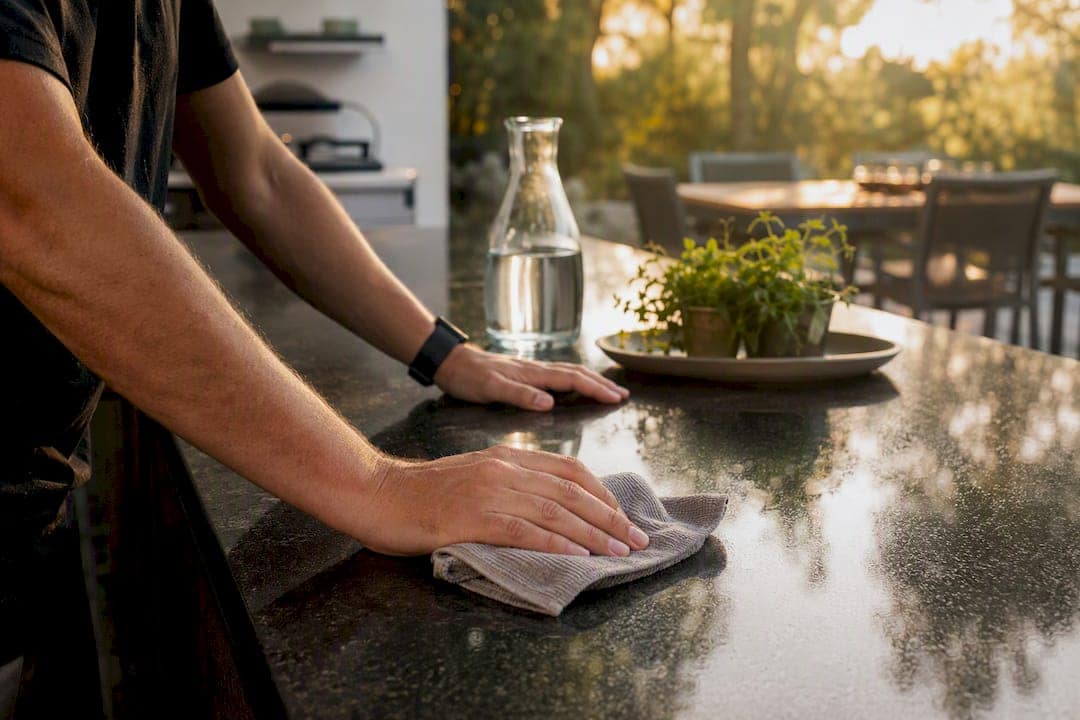
Quartz countertops are nonporous, so they almost never need sealing, and the single most effective thing you can do for stain protection is wipe up spills fast and clean with mild soap and a microfiber cloth. That’s it. That’s the headline. No topical sealer, wax, or “quartz protectant” spray is going to outperform basic habits, and several manufacturers actively warn against applying one.
Do this today:
Avoid bleach, oven cleaner, and anything with a very high or very low pH until you’ve read the section below. Those products don’t just risk a stain. They can permanently etch the surface, and no amount of scrubbing brings that back.
Quartz resists staining because it’s nonporous, but the resin binder holding it together is vulnerable to solvents, high heat, and harsh chemicals, so protection means smart habits, not sealers.
| Point | Details |
|---|---|
| Skip the sealer | Quartz is nonporous and manufacturers advise against topical sealers, which can yellow or peel. |
| Build a daily habit | Wipe spills immediately and clean with mild soap, water, and a microfiber cloth. |
| Escalate carefully | Try soap and water first, then Bar Keepers Friend liquid, then 70% isopropyl alcohol for tough spots. |
| Know the etching test | Run a fingernail over a mark; texture change means permanent etching that requires a professional. |
| Consider physical protection | Ppf installs countertop protective film in Calgary and Winnipeg for a near-maintenance-free surface. |
Engineered quartz isn’t solid stone. It’s mostly crushed natural quartz mixed with polymer resin and pigment, compressed under heat and vacuum into a dense, nonporous slab. That manufacturing process is exactly why quartz resists staining better than granite or marble. There are no open pores for wine or oil to seep into, which is the main reason most manufacturers say sealing isn’t required at all.
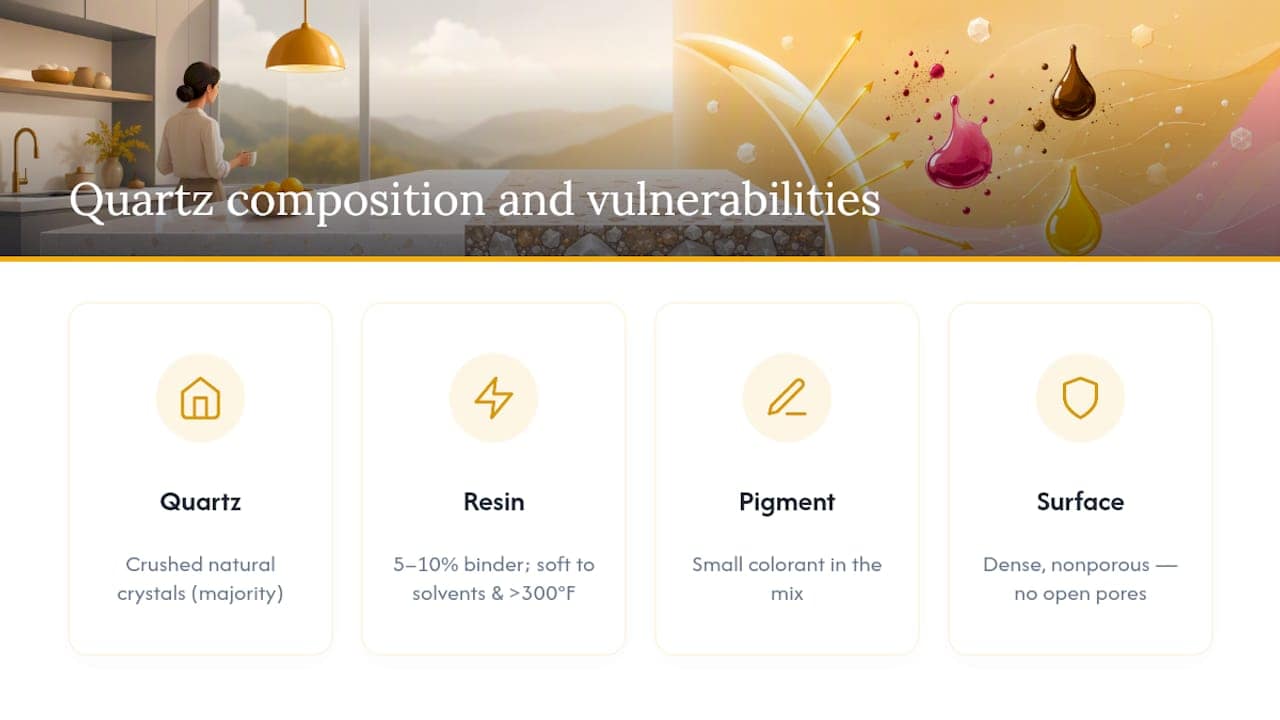
But that resin binder, usually somewhere between 5 and 10 percent of the slab, is also the material’s soft spot. Natural quartz crystal can shrug off almost anything short of a jackhammer. The resin holding it together cannot. Strong solvents like acetone or paint stripper can soften or dissolve that binder on contact. High heat does similar damage: surface temperatures above roughly 300°F can scorch the resin in a matter of seconds, leaving a discolored ring that no cleaner will lift because the material itself has changed structure, not just picked up a stain.
Sunlight adds a slower version of the same problem. UV exposure over months or years can yellow certain finishes, white and light-colored slabs being the most visibly affected, which is a big reason quartz isn’t recommended for outdoor kitchens in the first place.
So when people ask, “Is quartz stain resistant?” the honest answer is yes, remarkably so, for anything that just sits on the surface. What it can’t resist is chemical attack on the resin or heat that exceeds its tolerance. Understanding that distinction changes how you clean it, what you keep under the sink, and why some marks that look like stains are actually something you can’t undo.
Most quartz problems trace back to skipped basics, not exotic accidents. A simple routine handles the vast majority of what a busy kitchen throws at a countertop.
Daily:
Weekly:
For spot problems, two products earn a permanent place under your sink. 70% isopropyl alcohol on a cloth handles ink, marker, and most grease stains without touching the resin. MSI Surfaces specifically recommends it for sanitizing and spot-lifting stains that soap and water leave behind. Bar Keepers Friend liquid (not the powder) is the next step up for dried food residue, hard water film, or light discoloration, but use it sparingly. Apply a small amount, let it sit for a minute, wipe with a soft cloth, and rinse thoroughly. Don’t scrub it in circles with a stiff brush.
It becomes a two-second habit instead of a special-occasion cleaner, and that habit alone prevents the majority of stain-related headaches before they start.*
Neither of these replaces daily soap and water. They’re for the stains that daily cleaning misses, used occasionally rather than as your default cleaner.
Some products and habits don’t just fail to clean quartz. They actively degrade it, sometimes permanently, and the damage often isn’t obvious until weeks later when a dull patch or faint ring shows up.
Keep these away from your countertop entirely:
That last point matters because it runs against instinct. Granite owners are used to sealing their counters annually, so it feels responsible to do the same with quartz. It isn’t. The nonporous resin surface doesn’t absorb sealer the way stone does, and an incompatible topical product can trap moisture underneath or react with the pigments, creating the exact haze you were trying to prevent.
Repeated exposure to any of these, even in small doses over years, gradually clouds the finish. It’s rarely one dramatic incident. It’s usually a slow accumulation of “just this once” moments with the wrong cleaner.

Most marks on quartz respond to a simple escalation, and you should work through it in order rather than jumping straight to the strongest option.
That last distinction is the one homeowners miss most often. Run a fingernail lightly over the mark. If the surface feels smooth and the discoloration is purely visual, you’re dealing with a surface stain that responds to cleaning. If you feel a dip, a rough patch, or a slightly different texture, that’s etching, and no household chemical reverses it because the resin itself has been chemically altered, not just discolored.
A poultice (a paste of baking soda and water left overnight under plastic wrap) or a Magic Eraser can lift some genuinely stubborn residue, but treat both as last resorts, not go-to tools. Architectural Digest has documented cases where overuse of an abrasive eraser pad removed the original mark but left a larger, duller halo around it, which then required professional resurfacing to fix. Test any last-resort method in an inconspicuous spot first, like under the sink lip, before working on a visible section of counter.
Most quartz manufacturers offer long-term warranties, often up to lifetime coverage, but the fine print usually excludes damage from heat, harsh chemicals, and outdoor installation. That last exclusion matters more than people expect, since UV exposure can yellow certain finishes over time and outdoor kitchens frequently fall outside standard coverage entirely.
Before you touch a stubborn stain with anything beyond soap and Bar Keepers Friend, protect your ability to file a claim later:
Repair costs vary widely depending on damage severity, but expect professional resurfacing or color-matched resin repair to cost meaningfully more than the cleaning products that could have prevented the damage in the first place.
Daily cleaning and smart habits handle most situations, but some households are better off adding a physical layer of protection rather than relying on vigilance alone.
Countertop protective film works as a clear barrier applied directly over the quartz surface. It doesn’t change how the counter looks, but it absorbs the abuse that would otherwise reach the resin: acidic splashes, hot cookware set down absentmindedly, dragged pans, kids’ science experiments. Properly installed film typically lasts several years before it needs replacing, and swapping it out is far cheaper than resurfacing a damaged slab.
Consider it worth the investment if:
Pro Tip: Ask any installer for the film manufacturer’s data sheet before booking. It should specify expected lifespan and chemical resistance, not just “protects your counter” marketing language.
Ppf installs countertop protective film as part of its surface protection lineup, applying the same precision used on automotive paint protection film to kitchen counters, giving surface-conscious homeowners a near-maintenance-free option.
Daily wiping and keeping isopropyl alcohol under the sink is a five-minute habit, and it prevents the vast majority of stains before they ever set. White quartz owners need to be more disciplined about it. Every haze or ring shows up faster on light stone.
For rentals or heavy-use kitchens, professional protective film is a reasonable investment against unpredictable tenants or kids, not a luxury. Check your manufacturer’s care guide first. When you hit real etching or scorch damage, stop experimenting and call a professional.
If daily cleaning feels manageable but you’d rather not gamble on hot pans, wine nights, or a renter’s cleaning habits, a physical layer of protection solves that problem permanently instead of case by case. Ppf installs countertop protective film for homeowners who want their quartz to stay showroom-clean without babysitting every spill.

The process starts with an inspection and measurement visit, where the team checks your slab’s condition, maps seams and edges, and walks you through expected timeline before any film goes down. Applied by Ppf’s team in Calgary and Winnipeg, the film uses the same self-healing, high-clarity material approach the company applies to vehicle paint protection, adapted for kitchen use. Ask about warranty terms and request the product data sheet during your consultation so you know exactly what’s covered.
Ready to stop worrying about stains and heat marks? Book a countertop PPF consultation in Calgary or check service availability across both locations to get a quote.
Manufacturer care pages carry the most weight for warranty-related questions, since they set the exact terms your coverage depends on. Cambria’s product care guidance confirms sealing isn’t required for its slabs, while StoneTech Fabrication’s care guide details why aftermarket sealers are discouraged industry-wide. MSI Surfaces and The Spruce both offer practical cleaning escalation steps, and D and G Flooring covers heat and chemical damage thresholds in more technical detail.
Wipe spills immediately, clean daily with mild soap and water, and use trivets for hot pans. Quartz’s nonporous surface already resists most staining, so prevention is mostly about speed and avoiding harsh chemicals.
Yes, though it’s rare. Deep etching from strong acids, high-pH cleaners, or heat above roughly 300°F can permanently damage the resin binder, and that kind of damage requires professional resurfacing rather than home cleaning.
There isn’t a topical protectant worth buying, since manufacturers advise against aftermarket sealers. The most effective protection is a daily soap-and-water routine, plus professional countertop film for households that want an added physical barrier.
If quartz seems to stain more than expected, the culprit is usually acidic or pigmented substances left sitting too long, like wine or turmeric, or a cleaner that’s dulling the finish over time. Bar Keepers Friend liquid and isopropyl alcohol usually resolve residue that soap and water leave behind.

Calgary
Winnipeg
Calgary
Winnipeg