

Windshield protection film is worth hiring a professional for if you drive a newer vehicle with ADAS cameras, cover a lot of miles on gravel or highway routes prone to debris, or simply want to avoid the cost and hassle of chip repairs and full replacements. The math gets less compelling on older, lower-value cars with minimal safety tech and light city driving. Vehicle value, driving environment, and budget decide the answer, not a blanket yes or no.
TL;DR:
- Windshield protection film is most cost-effective for newer, ADAS-enabled vehicles driven frequently on gravel or high-debris routes.
- Proper installation by an experienced professional ensures the film fits precisely, seals edges well, and does not interfere with sensors.
- Routine care, including avoiding dry wiper use and rinsing off loose grit, can extend the film’s effective lifespan to 7–12 years.
- The film reduces small debris chips significantly but cannot prevent cracks caused by large impacts or existing damage.
- A single chip repair often costs less than the installation, but on ADAS vehicles, the protection also helps avoid costly recalibration expenses.
Windshield protection film is a thin, clear polyurethane layer bonded directly to the glass. When a rock or piece of debris hits bare glass, the impact energy has nowhere to go, and it concentrates at one point, which is why a small stone can start a chip that spreads into a crack. Film spreads that same energy across a wider area and absorbs part of it, so the glass underneath takes a softer hit.
Independent gravelometer testing under SAE J400 backs this up. Manufacturers cite films passing that standard at a fairly high pressure threshold with minimal small chips, a level that unprotected glass typically fails at much lower pressure.
Film has limits, though:
Run your vehicle and habits through this before you decide:
Pro Tip: If you’re on the fence, tally how many chips or cracks you’ve dealt with in the last three years. Two or more is usually a clear signal that protection is worth the upfront cost.
Professional installation cost reflects three things: the film itself, the labor to cut and fit it precisely to your windshield’s curve, and the installer’s experience with edge sealing and ADAS-aware placement. Poor fitting is where DIY kits and inexperienced installers usually fail, leaving lifted edges or bubbling that shortens the film’s life.
To estimate your own return, compare the install cost against realistic alternatives:
A quality install starts with thorough glass prep, since any dust or residue trapped under the film causes early lifting. The installer then measures and cuts the film to the windshield’s exact curve, applies it with careful edge sealing so moisture and debris can’t work underneath, and checks optical clarity once it has cured.
Pro Tip: Get the warranty terms and care instructions in writing before you pay. A verbal promise is not a warranty.
How long windshield film stays clear and effective depends heavily on how you treat it. Running wipers on dry glass grinds grit against the film’s surface and speeds up haze and micro-scratching, while gravel roads, road salt, and extreme temperature swings all shorten its useful life faster than gentle daily driving.
Quality film with routine care can reach 7 to 12 years of service backed by manufacturer warranties and periodic inspection.
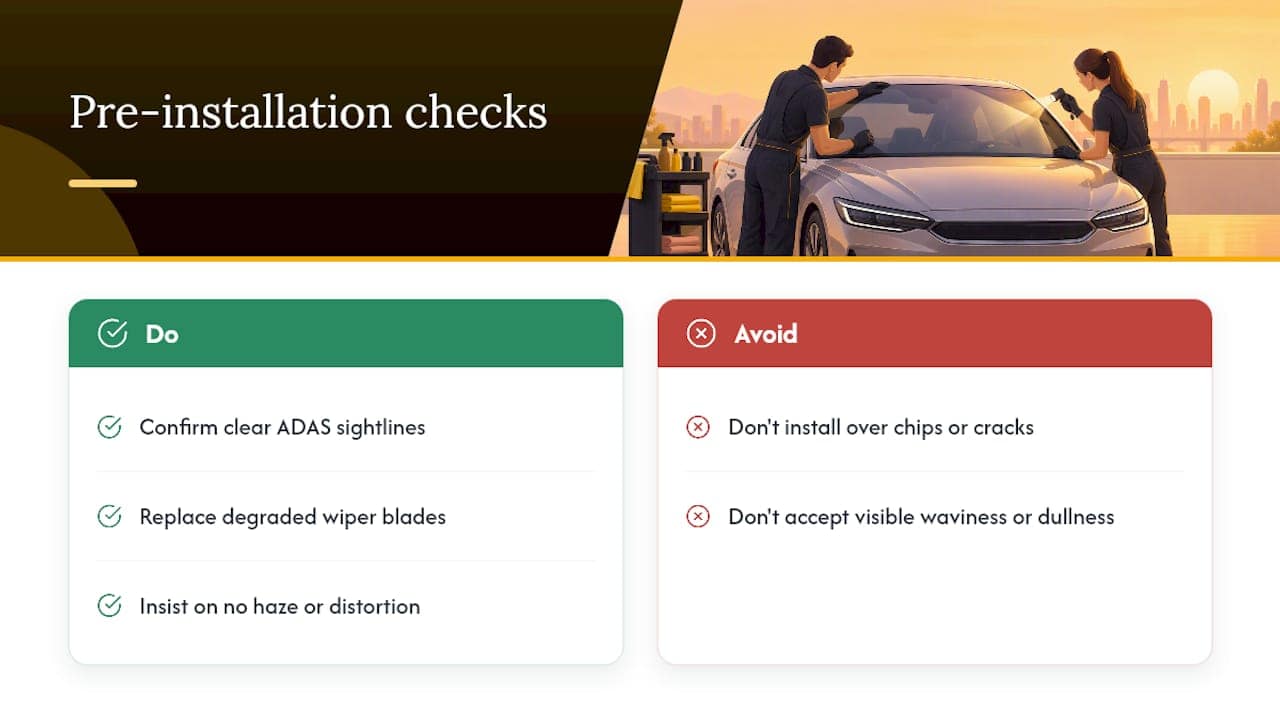
Well-installed film should look nearly invisible in normal light, with no noticeable haze, distortion, or edge lifting. Any visible waviness or dullness right after installation usually points to a low-quality film or a rushed job, not a normal characteristic of the product.
For ADAS-equipped vehicles, a professional installer should confirm the film doesn’t interfere with camera or sensor lines of sight, since these systems rely on a clear field of view through a specific patch of glass. Skip installation if the windshield already has a chip, crack, or degraded wiper blades that could grind debris into the new film right away.
Experienced installers suggest that windshield protection film delivers the most value on ADAS-equipped and luxury vehicles, where a single chip can mean an expensive recalibration. For older, lower-value cars driven mostly in the city, the case is weaker. It is recommended when your vehicle, driving habits, and budget line up, backed by good workmanship and a clear warranty.
A professional windshield PPF service pairs precise, ADAS-aware installation with tailored solutions that provide newer and higher-value vehicles practical protection against chips without guesswork on fit or sensor placement.
| What you get | Why it matters |
|---|---|
| Precise, measured film fit | Reduces edge lifting and early failure |
| ADAS-aware placement checks | Protects camera and sensor visibility |
| Written warranty and care instructions | Clear expectations after installation |
Ready to see if it’s right for your vehicle? Get a quote through the windshield PPF page and find out what a professional install looks like for your car.
It’s typically worth it if you drive an ADAS-equipped or higher-value vehicle, cover a lot of miles on gravel or highway routes, or want to avoid the cost of chip repairs and recalibration. On older, lower-value cars driven mostly around town, the return is less clear.
With routine care, quality film can reach 7 to 12 years of service life. Lifespan depends heavily on wiper habits, road conditions, and climate exposure.
A professionally installed film should not block or distort a camera’s field of view when the installer checks sensor placement during fitting. Ask your installer to confirm sensor compatibility before the film is applied.
Testing under SAE J400 shows film can pass gravelometer testing at up to 70 psi with no more than four chips smaller than 1 millimeter, which means it meaningfully reduces small-debris damage. It will not prevent cracking from a large rock or a direct high-speed impact.
Professional installation offers precise fit, edge sealing, and ADAS checks that are difficult to replicate with a DIY kit. A poorly fitted film can lift, trap debris, or leave sensor areas obstructed, which is why hiring an experienced installer matters most on newer or higher-value vehicles.