

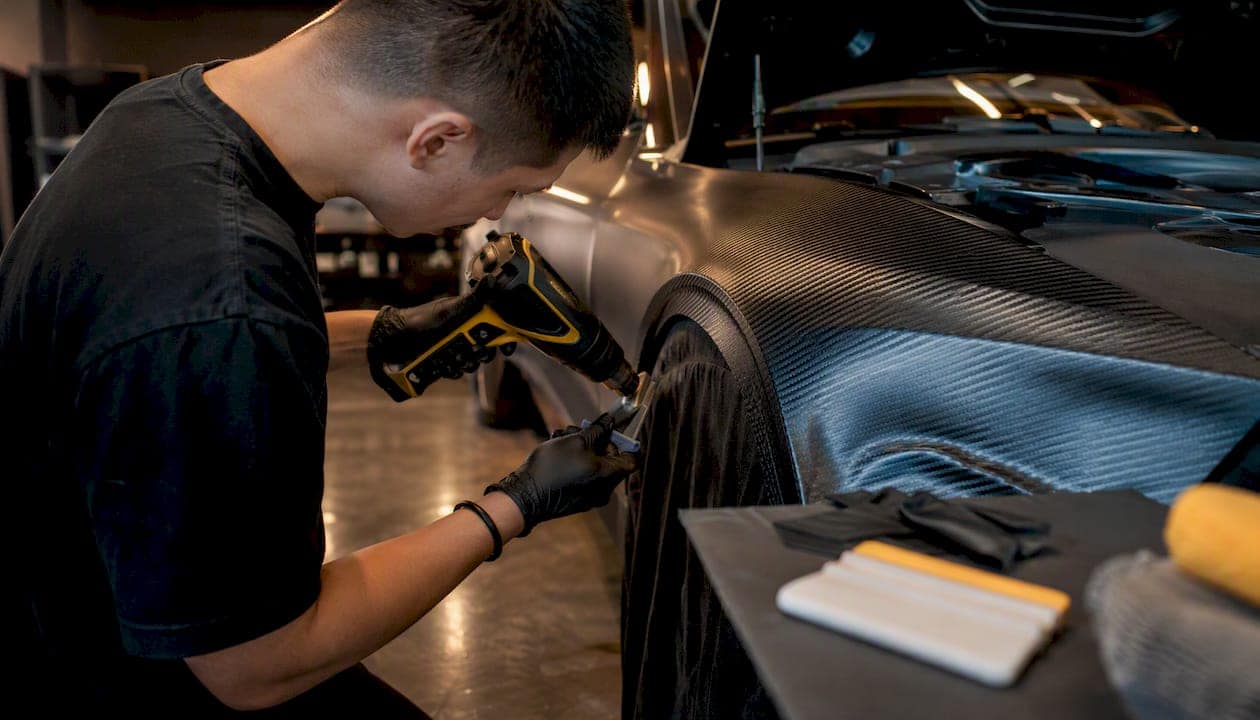
A professionally installed vehicle wrap using premium cast vinyl and a UV-resistant laminate typically lasts 5–7 years. With ideal climate, covered parking, and consistent maintenance, premium cast films can last up to 8–10 years under ideal conditions. Budget or DIY wraps using calendared film typically last a shorter time before visible failure.
Four variables move that range more than anything else:
Specialty finishes change the math entirely. Chrome and holographic films typically last a shorter time because their reflective particles degrade faster under UV. Cut contour graphics on flat panels, by contrast, can outlast a full wrap by years.
Wrap durability is an engineering problem, not just a question of brand or price. Five factors drive almost all of the variance.
Cast vinyl is manufactured by pouring liquid PVC onto a casting sheet, which produces a thin, dimensionally stable film with low memory, as technically explained in Automotive Fabrication UK | EV & Motorsport | JIENCO. Calendared vinyl is pressed through rollers under heat, which leaves residual stress in the material. That stress wants to release over time, pulling edges up and causing shrinkage, especially around curves and recesses. For a full color-change wrap, cast film is the only material worth using.
A UV-resistant overlaminate does two things: it blocks the wavelengths that bleach color and degrade adhesive, and it adds a physical barrier against abrasion. Skipping the laminate on a cast film is like buying good sunscreen and leaving it in the car. Most premium manufacturers publish 5–7 year lifespans specifically for laminated systems, not bare film.
Initial tack and ultimate bond are not the same thing. Premium adhesives are repositionable for 24–72 hours before reaching full strength. Returning a freshly wrapped vehicle to heavy sun exposure or a pressure wash during that window can reduce long-term bond integrity. Post-heat applied to seams and recesses is equally critical: it relaxes the film’s memory and locks edges down. Skipped post-heat is one of the top causes of early edge failure.
UV index, ambient temperature, and road chemistry all matter. Salt from winter roads wicks under lifted edges. Industrial pollutants and acid rain etch the laminate surface. A vehicle parked outdoors in Phoenix ages a wrap faster than the same vehicle garaged in Seattle.
Pro Tip: Apply a wrap-safe ceramic topper within 30 days of installation, before the laminate surface accumulates any contamination. It bonds better to a clean, fresh surface and the UV protection compounds over time.
Lifespan varies significantly by wrap type, finish, and how the vehicle is used. The table below reflects professionally installed wraps with proper lamination under average US conditions.
| Wrap Type / Finish | Expected Lifespan | Best For | UV / Climate Sensitivity | Relative Cost |
|---|---|---|---|---|
| Full cast wrap (standard gloss/satin) | 5–7 years | Full color change, personal vehicles | Moderate | Mid–high |
| Premium cast + UV laminate | up to 8–10 years under ideal care | Enthusiast builds, long-term ownership | Low–moderate | High |
| Cut contour graphics (cast) | longer lifespan than full wraps on flat panels | Partial accents, stripes, decals | Low (flat panels) | Low–mid |
| Perforated window vinyl | shorter lifespan | Rear window graphics, privacy | High (direct sun) | Low–mid |
| Chrome / holographic specialty | short lifespan | Show vehicles, short-term use | Very high | High |
| Matte / satin finish | generally several years | Stealth builds | Moderate (shows scratches) | Mid–high |
| Fleet / high-mileage vehicles | 4–6 years | Commercial graphics, delivery fleets | Moderate | Mid |

Horizontal surfaces age fastest. Hoods, roofs, and trunk lids face direct UV exposure at a perpendicular angle for hours every day. On a vehicle with an otherwise healthy wrap, the hood often shows fading or cracking 12–18 months before the doors do. Specialty finishes like chrome and holographic films typically last only 1–3 years because the reflective particles and adhesive systems degrade faster under UV, regardless of laminate quality.
Manufacturer warranties from brands like 3M and Avery Dennison are a practical reference point. Both publish warranty terms for their premium cast systems that align with several years of warranty when paired with correct installation and lamination. Those warranties typically cover fading and delamination under normal use, not physical damage or improper care.
Maintenance is disproportionately effective. Simple, consistent habits often add multiple years to a wrap’s useful life.
Pro Tip: After any wash, run a clean dry finger along all edges and seams. You’re feeling for any section that has lifted even slightly. Catching a 2mm lift costs nothing to fix; ignoring it for three months can mean a full panel rewrap.
For carwash specifics: touchless automated washes are acceptable for wrapped vehicles, but hand-washing remains the safest option. If you use a pressure washer, keep the nozzle at least 12 inches from the surface, use a wide-angle tip (40 degrees or wider), and never direct the stream at an edge or seam at an acute angle. The water pressure itself rarely damages vinyl; the angle does.
The installation is the single biggest non-material determinant of longevity. Poor surface prep, skipped post-heat, or a dusty shop environment accelerate failure faster than almost any other variable.
Installer checklist:
Questions worth asking directly:
Warranty items to require in writing:
Check the portfolio and before/after work of any installer you’re considering. A shop confident in its work shows it.
Installers consistently report that climate is the variable clients underestimate most. A wrap installed in a hot, high-UV region like Arizona or Southern California ages noticeably faster than the same film in a temperate climate. Garaged vehicles in those same regions often outlast outdoor-parked vehicles in milder climates.
Adhesive behavior surprises many first-time wrap owners. The film feels secure immediately after installation, but the adhesive hasn’t reached full strength yet.
Returning a freshly wrapped vehicle to heavy sun, rain, or a pressure wash within the first 24–72 hours can compromise the long-term bond, even when the wrap looks perfect on the surface. The adhesive needs time to fully cure against the paint.
The most common failure modes installers see are edge lift on bumpers and mirrors (usually from skipped post-heat or inadequate surface prep), fading on hoods and roofs (UV and laminate quality), and peeling at door seams (moisture intrusion after minor edge lift). All three are preventable with the right film, proper installation, and basic maintenance.
Location shapes vinyl wrap durability more than most buyers realize. UV index, temperature swings, humidity, and road chemistry all vary by region, and each one affects a different part of the wrap system.
In high-UV states like Florida, Texas, Arizona, and California, the laminate absorbs more UV radiation per year than the same film in the Pacific Northwest or New England. Installers in those markets routinely quote shorter expected lifespans and more strongly recommend UV-protective ceramic toppers. Seasonal temperature swings matter too: repeated freeze-thaw cycles in northern states stress adhesive bonds at edges, particularly on vehicles parked outdoors year-round.
Winter road salt is a specific threat in the Midwest and Northeast. Salt spray wicks under any lifted edge and accelerates adhesive breakdown. Vehicles in those regions benefit from more frequent washing during winter months and a close edge inspection every spring.
Humidity affects the installation window more than the wrap’s ongoing life, but high-humidity environments can slow adhesive cure and promote moisture trapping under imperfectly sealed edges. In the Canadian prairies, where Ppf serves Calgary and Winnipeg customers, the combination of intense summer UV and harsh winter conditions makes laminate quality and edge sealing especially important.
3M and Avery Dennison are the two names that appear most consistently in professional installer specifications, and for good reason. Both publish detailed datasheets for their premium cast film series, and both back those films with manufacturer warranties that cover fading and delamination under normal use.
3M’s 1080 and 2080 series are cast films designed for full vehicle wraps. The 2080 series is 3M’s current premium line, with improved conformability over the 1080. Avery Dennison’s Supreme Wrapping Film (SWF) series is a direct competitor, also cast, and widely used by professional installers for complex full-vehicle applications. Both brands publish 5–7 year lifespan guidance for their premium cast systems when installed with proper lamination.
HEXIS, a French manufacturer with US distribution, publishes similar warranty terms for its Skintac series. Oracal (by ORAFOL) is widely used for cut graphics and fleet applications; its 970RA series is a cast film rated for outdoor durability, though it is less commonly specified for full color-change wraps than 3M or Avery Dennison.
The practical difference between brands at the premium cast tier is smaller than the difference between cast and calendared film within any brand. A professionally installed Avery Dennison SWF wrap will outlast a budget calendared film from any manufacturer by years.
Chemical exposure is a slower threat than UV but equally damaging over time. Acid rain, which forms when sulfur dioxide and nitrogen oxides from vehicle exhaust and industrial emissions mix with atmospheric moisture, etches vinyl laminate surfaces the same way it etches clear coat. The damage appears as a dull, pitted texture that no amount of washing removes.
Industrial fallout, the fine metallic particles from brake dust and rail lines, embeds in the laminate surface and oxidizes. Left in place, those particles create micro-abrasions and discoloration. A wrap-safe iron decontamination spray removes embedded fallout before it bonds permanently; use it twice a year in urban or industrial environments.
Road salt is the most immediate chemical threat in northern climates. Salt accelerates corrosion under any gap in the film and degrades adhesive chemistry at edges. Washing the undercarriage and lower panels after every significant winter storm is not excessive; it is the single most effective thing you can do to protect both the wrap and the paint underneath it.
Bird droppings and tree sap are the most underestimated chemical threats. Both are acidic, and both bond to vinyl laminate quickly in heat. Remove them within 24 hours using a wrap-safe spot cleaner; leaving them for a week in summer sun can permanently etch the surface.
A vehicle in long-term storage is not automatically safe from wrap degradation. The threats change, but they don’t disappear.
UV exposure is the primary concern for outdoor storage. A car cover rated for UV protection is worth the investment for any vehicle stored outdoors for more than a few weeks. Even under a carport, reflected UV from surrounding surfaces accumulates.

Moisture is the concern for indoor storage. A garage with poor ventilation traps humidity, which promotes mold growth under any lifted edge and can cause the adhesive to soften and release over time. Store wrapped vehicles in a dry, ventilated space and leave a small gap at windows to allow air circulation.
For seasonal storage lasting several months, inspect the wrap before putting the vehicle away and address any lifted edges or surface contamination first. A wrap that goes into storage with a small problem comes out with a larger one. Apply a fresh coat of wrap-safe ceramic topper before storage to protect the laminate surface during the period of inactivity.
When returning a stored vehicle to regular use, wash it thoroughly before driving. Road debris and contaminants that accumulate during storage can scratch the laminate on the first drive if not removed first.
A professionally installed cast vinyl wrap with UV laminate typically lasts 5–7 years, and consistent maintenance, covered parking, and a wrap-safe ceramic coating can push that toward 8–10 years.
| Point | Details |
|---|---|
| Core lifespan range | Premium cast vinyl with UV laminate lasts 5–7 years professionally installed; up to 8–10 years with ideal care. |
| Film type matters most | Cast vinyl outlasts calendared film significantly; specialty finishes like chrome last only 1–3 years. |
| Installation is decisive | Surface prep, post-heat on seams, and a climate-controlled shop determine longevity as much as film quality. |
| Maintenance extends life | Garage parking, hand-washing, and a wrap-safe ceramic topper are the three highest-impact habits. |
| Ppf for Calgary and Winnipeg | Ppf installs premium cast wraps with ceramic coating options, serving Calgary and Winnipeg vehicle owners. |
Most people shopping for a wrap focus on color and price. The question they should be asking is: what film, what laminate, and who is doing the post-heat?
The gap between a 3-year wrap and a 7-year wrap is almost never the brand of film. It is the laminate choice, the surface prep, and whether the installer took the time to heat every seam and recess properly. A premium film installed carelessly will fail before a mid-tier film installed meticulously.
The other thing buyers consistently underestimate is the cost of doing nothing after installation. A wrap that gets washed twice a year and parked outdoors in a sunny climate will look rough at year three. The same wrap, hand-washed regularly, ceramic-coated, and garaged, can look sharp at year six. That difference is not about the film. It is about 20 minutes every two weeks and a covered parking spot.
If you are weighing wrapping against repainting, the honest comparison is not just upfront cost. It is total cost over the ownership period, including the protection the wrap provides to the original paint and the resale value that paint condition represents. A wrap that comes off cleanly at year six revealing factory paint in excellent condition is a financial win, not just an aesthetic one.
Ppf brings over 30 years of combined experience to every installation, which means the team has seen what separates a wrap that lasts from one that fails at year two. The difference is almost always in the details: film selection, surface prep, post-heat discipline, and the right protective add-ons for your climate.
For Calgary and Winnipeg vehicle owners, Ppf offers professional car wrap installation using premium cast films, paired with ceramic coating options that extend wrap life and simplify maintenance. Whether you’re wrapping a daily driver or a weekend build, the team provides a written lifespan estimate for your specific vehicle and climate, not a generic number. Explore Ppf’s service locations or book a consultation to get a quote tailored to your vehicle.
The main downsides are a finite lifespan (typically 5–7 years for premium cast), specialty finishes that last only 1–3 years, and removal risk if the wrap ages past its intended lifespan or was installed with low-quality adhesive.
Touchless automated washes are acceptable, but friction or brush carwashes should be avoided entirely, as spinning brushes catch film edges and accelerate peeling. Hand-washing is the safest option.
A professional full wrap using cast film typically runs $2,500–$4,000 for a mid-size sedan at the mid-tier; premium cast with UV laminate can reach $7,000 or more depending on vehicle complexity and finish.
A quality respray on a full vehicle typically costs more upfront than a mid-tier wrap, but a wrap needs replacement every 5–7 years. Wrapping wins on reversibility and paint protection; painting wins on permanence.
Hand-wash every 1–2 weeks with wrap-safe soap, apply a wrap-compatible ceramic coating, park in a garage or covered structure, and inspect edges monthly to catch any lift before it spreads.

Calgary
Winnipeg
Calgary
Winnipeg