
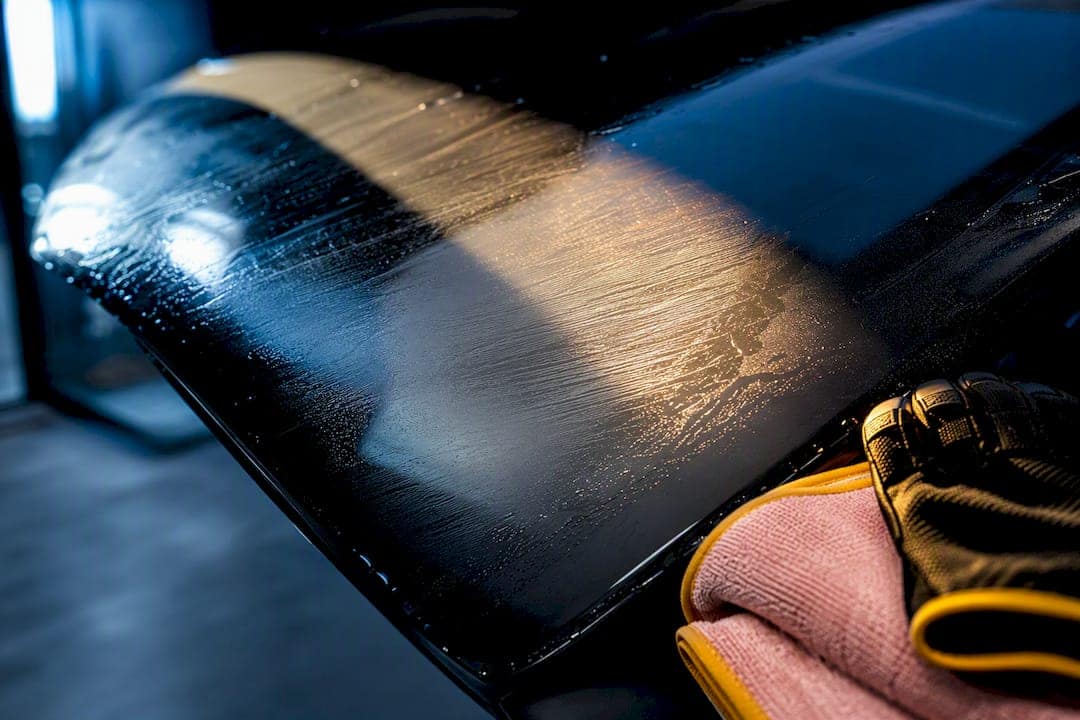
Self-healing paint protection film genuinely repairs surface-level scratches and swirl marks, but it can’t rebuild material that’s actually missing, like a rock-chip crater or a knife cut. The topcoat’s polymer chains regain mobility with heat, whether from sunlight, warm water, or a heat gun, letting the surface reflow smooth. For owners, that means noticeably less time buffing out light marks, provided the film is installed and cared for correctly.
TL;DR:
- Self-healing paint protection film repairs only surface-level scratches and swirl marks, not material loss from deep cuts or rock chips.
- The topcoat’s heat-activated polymer chains reflow surface marks when exposed to sunlight, warm water, or a heat gun, with healing times varying by climate.
- Proper installation, edge sealing, and maintenance are essential, as poor application can severely limit the film’s self-healing performance.
- Instant-healing formulations work at or near room temperature but tend to be less durable than heat-activated ones, which perform better in warmer, sun-heavy climates.
- Regular washing with pH-neutral soap and avoiding abrasives are vital to maintain the film’s self-healing ability over its roughly 10-year lifespan.
Paint protection film isn’t a single sheet of plastic. It’s a stack of layers, and each one does a different job. Understanding that stack matters because it explains why some scratches vanish overnight and others never will.
At the bottom sits the adhesive and primer layer, bonding the film to your clear coat without trapping air or yellowing over time. Above that is the structural workhorse: a thermoplastic urethane (TPU) base film that absorbs rock strikes and road debris, the same way a car’s crumple zone absorbs a collision. On top of the TPU sits the elastomeric topcoat, and this is where the “self-healing” claim actually lives.
That topcoat is engineered so its polymer chains stay loosely mobile rather than locked into a rigid crystalline structure. Scratch it, and you’re not gouging out material, you’re just displacing chain segments and leaving a distorted surface. Add heat, and those chains gain enough energy to slide back toward their lowest-energy shape, essentially “remembering” the smooth surface they started with. Some formulations use this shape-memory effect through thermal activation alone; others build in dynamic covalent bonds or reversible cross-links that reform automatically once temperature and mobility line up.
The lab data backs this up. Research on thermoplastic vulcanizates with ionic cross-links found scratch-recovery rates above 87% after thermal exposure, which is a meaningfully high number for a material that started life as a rigid, damaged surface. That figure comes from controlled lab conditions, not a driveway in February, but it demonstrates the underlying chemistry works when temperature and polymer design line up correctly.
Key layers in a typical self-healing PPF stack:
According to a materials overview from Paint protection film architecture, premium film lines built on this layered approach advertise serviceable lifespans of up to about 10 years when installed and maintained properly. That durability claim only holds up, though, if the topcoat itself stays chemically intact, which is where installation quality and aftercare start to matter as much as the material science.
Not all self-healing film behaves the same way, and the difference comes down to how much heat the topcoat needs before it starts reflowing.
Heat-activated systems are the more common design. Their topcoat chemistry is tuned to stay firmer at room temperature, which gives you better scratch and swirl resistance during everyday driving, then loosens up once you cross a specific activation threshold, typically triggered by direct sun, warm water, or applied heat. The trade-off is patience: on a cold, overcast day, that light swirl mark might sit there for a week until conditions cooperate.
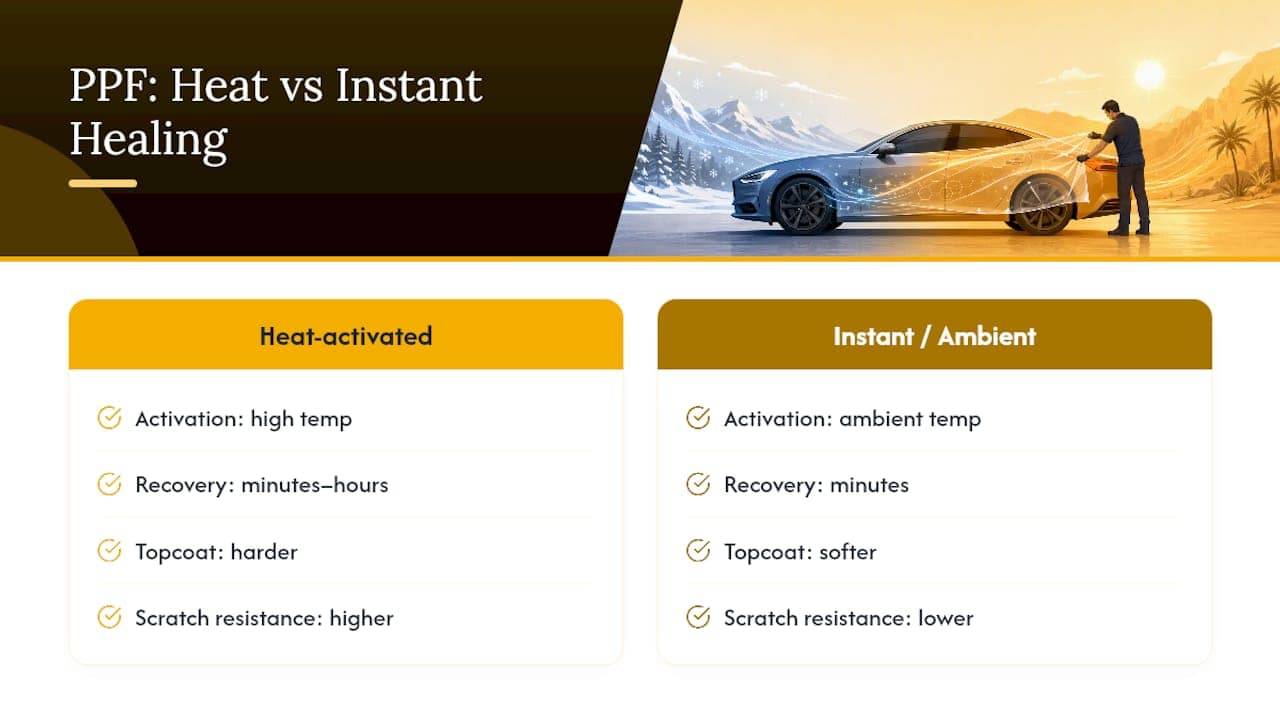
Instant or ambient-healing systems flip that balance. Their topcoats use a softer, more mobile elastomer or dynamic covalent chemistry that starts reflowing at or near room temperature, so scratches can fade within minutes without any intervention. The cost is durability. A softer topcoat is more prone to marring under repeated washing or aggressive contact, and it can show fine scuffing faster than a harder, heat-activated formulation.
Photothermal-responsive approaches sit at the experimental edge of this comparison. Research into light-driven shape-memory polymers with photothermal fillers found some formulations raising local surface temperature to nearly 78 degrees Celsius within seconds under targeted light exposure, enabling near-instant recovery. That technology hasn’t scaled to mainstream automotive film yet, mostly due to manufacturing cost and long-term durability questions, but it signals where the category is heading.
Pro Tip: If your car sits in a garage most of the year and only sees direct sun on weekend drives, a heat-activated film may leave swirl marks visible longer than you’d like. Ask your installer about hybrid formulations that balance hardness with faster ambient recovery.
Practically, this becomes a climate and parking-habit decision. Vehicles that live outdoors in sun-heavy regions get near-automatic healing from heat-activated films all season long. Cars parked in garages or colder markets benefit more from instant-healing formulations, or from owners who are willing to run a heat gun occasionally.
The single biggest misconception about this technology is that it makes a car scratch-proof. It doesn’t. It makes surface-level marks temporary, and that’s a real distinction most sales pitches gloss over.
Practitioner reporting on real-world results confirms this pattern: installers consistently find that surface marks heal within minutes to hours depending on ambient temperature, while anything involving actual material loss requires a patch or panel replacement. When damage crosses that line, replacing the affected section of film is still the right call. It’s cheaper and faster than repainting, and it keeps your factory clear coat untouched underneath.
Getting a stubborn swirl mark to disappear usually just takes patience and a little heat, but the method matters more than people assume.
The simplest approach is passive: park in direct sunlight for an afternoon, or rinse the panel with warm water right after a wash. Light swirl marks in warm ambient conditions often heal within an hour or two; on a heat-activated film in cooler weather, it can take a full day of consistent sun exposure before the mark fully disappears.
For faster results, a heat gun works, but technique matters. Hold the gun 6 to 10 inches from the surface, keep it moving continuously in slow, even passes, and aim for a panel surface temperature in the 140 to 180 degree Fahrenheit range, checked with an infrared thermometer if you have one. Never hold the gun stationary. That’s how you scorch a topcoat or lift an edge.
Safe activation checklist:
Pro Tip: If a scratch hasn’t healed after a full day of sun exposure, resist the urge to crank the heat gun higher. Bring it to a professional detailer instead. Shops often use steam or controlled infrared heat, which distributes temperature more evenly across the panel and is safer for edges and adhesive lines than a handheld gun.
Professional heat and steam tools exist for a reason: they apply even, controlled temperature across a larger surface area, reducing the risk of overheating one spot while leaving another mark untouched.
A self-healing topcoat isn’t a “set it and forget it” surface. What you wash it with, and how often, directly affects how long that healing ability lasts.
Stick to pH-neutral car soap and either hand washing or a touchless car wash. Harsh degreasers and high-alkaline soaps break down the topcoat’s surface chemistry over time, gradually reducing its ability to reflow after minor damage. Washing roughly every one to two weeks keeps contaminants from bonding to the surface and forcing more aggressive cleaning later.
Skip abrasive polishing compounds and clay bars unless a professional specifically recommends them for your film. These physically remove material from the topcoat rather than letting it heal, and they can strip away the thin surface layer that makes self-healing possible in the first place.
Signs the self-healing topcoat has degraded:
Manufacturer documentation on hydrophobic, heat-assisted topcoats points to durability claims of up to 10 years for premium film lines under proper care, though warranty coverage typically addresses defects like bubbling, discoloration, or adhesive failure rather than every cosmetic scratch. Read the fine print before assuming “10-year warranty” means unlimited healing performance for a decade straight. Our PPF maintenance guide breaks down wash-frequency and product recommendations in more depth.
Deciding whether self-healing film fits your car comes down to how you actually drive and park it, not just how much you love the paint.
On the installer side, ask about surface preparation, edge sealing, and film handling before you book anything. Poor prep traps contaminants under the film, which shows up later as bubbling that no amount of heat will fix. Unsealed edges let moisture creep in and lift the film prematurely. Watch for red flags: an installer who skips prep entirely, doesn’t seal edges, or pushes a rushed install in cold garage conditions where the adhesive can’t properly set. Our three-phase installation process walks through what proper prep and sealing actually look like.
The PPF Company has spent over 30 years of combined team experience installing paint protection film, ceramic coating, and window tint on vehicles across Calgary and Winnipeg, and that hands-on time reveals something the lab data alone can’t: healing performance depends as much on installation quality as it does on the polymer chemistry inside the film.
A perfectly engineered self-healing topcoat still underperforms if it’s installed over trapped dust or with sloppy edge work. That’s consistent with broader academic findings, too. Systematic reviews of self-healing materials in automotive contexts note that scaling this chemistry from lab success to reliable, long-term field performance remains a genuine engineering challenge, which is exactly why installer skill matters as much as material selection.
What that field experience translates into for owners:
If a scratch isn’t healing the way you expect, or you’re unsure whether existing film damage needs a patch versus a full panel replacement, a professional inspection beats guesswork every time.
Most self-healing PPF marketing implies the film is nearly indestructible. It isn’t, and treating it that way is where owners get burned. The technology solves a specific problem extremely well: the constant, low-grade cosmetic damage from wash swirls, branch scuffs, and parking-lot scrapes that used to require paint correction or a trip to a body shop.
Where conventional advice falls short is in setting activation expectations. Plenty of installers sell the film and never explain that a heat-activated topcoat in a cold climate might sit scratched for a week before it clears on its own. That’s not a defect. It’s physics, and owners deserve to know it going in.
If you’re prioritizing one thing, prioritize installer quality over topcoat brand. The chemistry differences between competing self-healing films matter less than whether the person applying it prepped the surface correctly and sealed every edge. A mediocre film installed perfectly will outperform a premium film installed carelessly, and that’s a truth the spec sheets never mention.
PPF is the practical next step if you’ve read this far and want the healing chemistry to actually perform the way it’s supposed to: correctly prepped surfaces, properly sealed edges, and film matched to how you actually drive and park. Skipping professional installation is where most self-healing PPF disappoints owners, not the material itself.
A team with over 30 years of combined installation experience handles every vehicle, whether a daily driver needing front-end coverage or a weekend car receiving full-body protection with ceramic coating for UV resistance. If you’re weighing PPF against ceramic coating alone, or wondering whether your specific vehicle needs partial or full coverage, book a consultation through the Cochrane paint protection film page or browse the full lineup of protection services to see what fits your car and your budget.
Self-healing PPF is a paint protection film with an elastomeric topcoat engineered to reflow and remove light surface scratches and swirl marks when exposed to heat, whether from sunlight, warm water, or a heat gun.
Pure Film’s product lines include self-healing topcoat technology on several of their film series, using thermal activation to repair light surface marks, though the exact chemistry and activation threshold vary by specific product line rather than applying uniformly across every film they sell.
XPEL’s Ultimate and Stealth product lines include self-healing topcoats designed to repair light scratches and swirl marks with heat exposure, following the same thermoplastic urethane base plus elastomeric topcoat structure common across premium self-healing films.
Light swirl marks often heal within minutes to a few hours in warm, sunny conditions, while healing is slower in cold weather and may require prolonged heat exposure.
No. Self-healing chemistry reflows displaced polymer material, but a rock chip removes material entirely, leaving a void that heat cannot rebuild. Rock chips typically require a patch or section replacement.
Yes. Washing with pH-neutral soap, avoiding abrasive polishes, and washing every one to two weeks helps preserve the topcoat’s chemistry so it continues healing effectively over the film’s lifespan.