
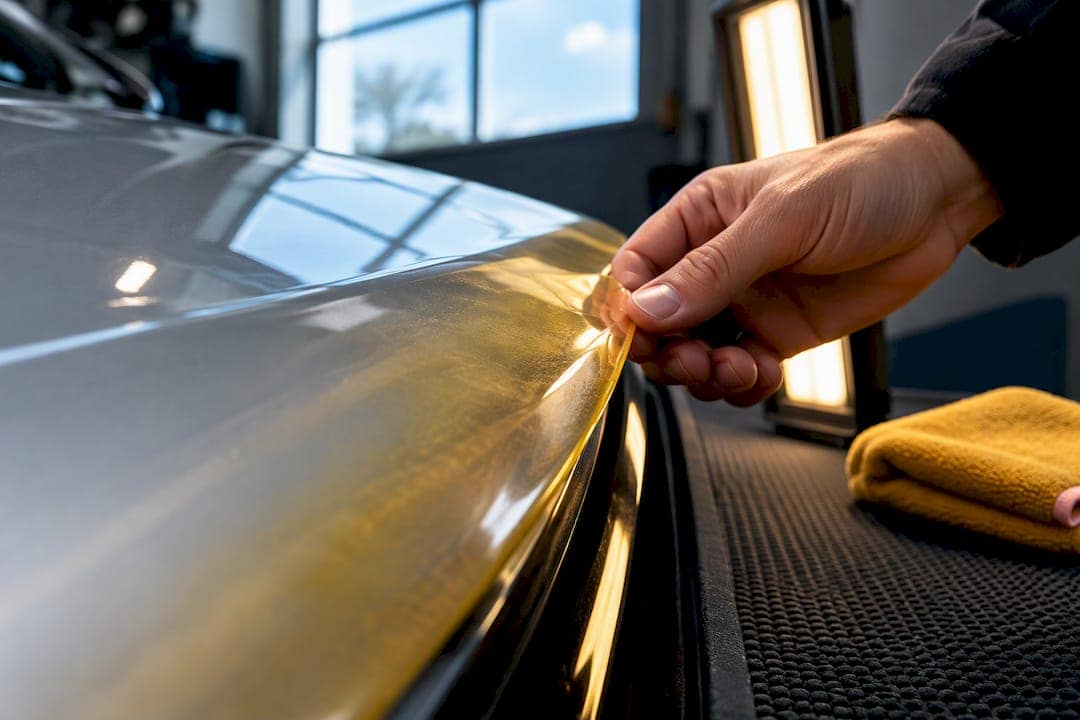
Modern high-quality paint protection film rarely yellows. If you chose an aliphatic TPU film, verified its anti-yellowing test data, and had it installed correctly, discoloration is uncommon over a normal service life. When you do spot yellowing, don’t panic and don’t assume replacement. Inspect the edges, hand-wash with a neutral shampoo, and see what’s actually going on before you call your installer.
TL;DR:
- Only high-quality aliphatic TPU films with verified anti-yellowing test data resist discoloration for over a decade, especially when properly installed and maintained.
- Yellowing mostly results from chemical reactions in aromatic TPU or environmental factors like UV exposure and improper installation, not from luck or external damage.
- Surface staining from dirt or residue can mimic yellowing but usually responds to hand washing and surface decontamination, unlike true chemical yellowing that penetrates the film.
- A warranty that explicitly covers yellowing and provides specific test results indicates a brand confident in its product’s long-term clarity.
- Proper surface prep, edge sealing, and avoiding harsh chemicals are essential proactive steps to prevent early discoloration and extend film lifespan.
Yellowing comes down to chemistry, not bad luck. Every paint protection film is built from a polyurethane base, and that base is either aliphatic or aromatic. That single distinction explains most of the yellowing complaints you’ll find online.
Aromatic TPU contains ring-shaped molecular structures that absorb ultraviolet light and convert it into chromophores, the light-absorbing molecules responsible for the amber tint you see on old vinyl or degraded plastics. Aliphatic TPU lacks those ring structures, so it resists that photooxidation reaction far more effectively. Buyer guides on film chemistry point to this as the primary reason some films discolor within a couple of years while others stay clear for a decade.
Material chemistry isn’t the only variable. A film can be built on solid aliphatic TPU and still discolor if something goes wrong elsewhere in the stack:
Here’s the part that surprises most owners: the reputation PPF has for yellowing was largely built by older-generation film. Early PPF products from a decade or two ago used cheaper aromatic polyurethane almost universally, and plenty of that film is still on cars today, slowly ambering. Detailing shops that field yellowing complaints regularly report that most cases trace back to old or low-quality film, not a fundamental flaw in the product category itself.
Quick fact: UV absorbers and hindered amine light stabilizers (HALS), the additives packed into a quality topcoat, work by intercepting UV energy before it can trigger the photooxidation reaction in the polymer chain below. A film without them is fighting UV exposure with no defense at all.
Not everything that looks yellow is chemical yellowing. This distinction matters because one problem costs you a hand wash and the other costs you a rewrap.
True chemical yellowing tends to be uniform across a panel and penetrates through the film’s structure rather than sitting on the surface. Run your finger over it and you won’t feel a texture change, and the discoloration won’t wipe away no matter what you use. Surface staining, by contrast, is usually patchy or localized. Think mineral deposits from hard water, insect residue baked on by the sun, or a film of road grime that’s built up in one spot near the wheel well.
Before you assume the worst, run through this sequence:
Pro Tip: Take a photo of any suspicious discoloration in direct sunlight and again in shade. Chemical yellowing usually reads the same in both light conditions, while surface contamination often looks worse or different under direct sun because of how light reflects off deposits sitting on the film.
If the wash test and decontamination step clear the mark, you’re done. If the color survives all four checks and you can trace it across multiple panels, escalate to a professional inspection rather than reaching for stronger chemicals, which can damage the film’s topcoat and make a cosmetic issue worse.
Prevention starts before the film ever touches your car, at the point where you’re choosing a product and an installer.
Before you buy, ask for these specifics:
At the installer level, insist on:
Once the film is on, maintenance becomes the variable you control. 3M’s own maintenance guidance recommends waiting a full 72 hours after installation before the car gets wet, since the adhesive needs that window to cure fully. After that:
The two-bucket wash method, using separate rinse and soap buckets with grit guards, is one of the simplest habits for avoiding swirl marks and preserving a clean finish on both PPF and paint.
The honest answer depends entirely on what’s causing the discoloration, which is why the diagnostic steps above matter so much before you spend money on either a detail or a rewrap.
Surface-level problems respond well to cleaning. Mineral staining from hard water, baked-on bug residue, light industrial fallout, and general road film all typically lift with a proper decontamination wash, sometimes paired with a clay bar or a dedicated iron-remover product. This is the outcome you want, and it’s more common than most owners expect.
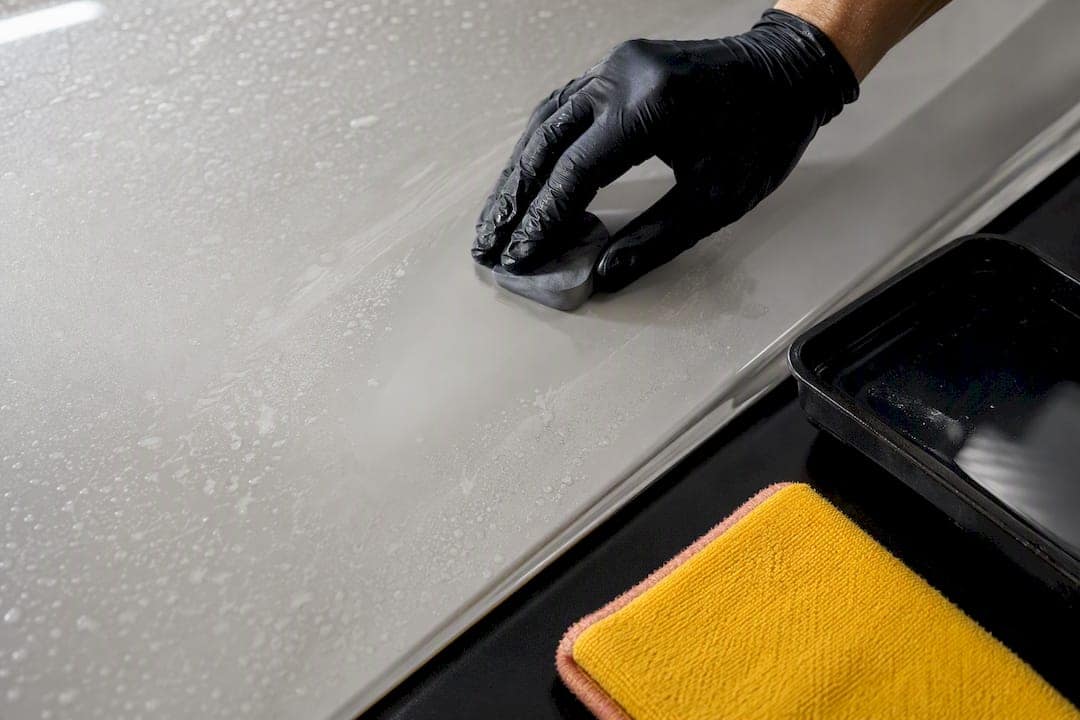
Polishing is a different story, and a riskier one. Some detailers attempt to polish out surface haze on PPF, but the film’s topcoat is thinner and softer than clear-coated paint. An aggressive compound or the wrong pad can cut through that topcoat, and once it’s gone, the film loses whatever UV resistance it had left. Treat polishing as a last resort, and only with PPF-safe products applied by someone experienced with film specifically.
Chemical yellowing that’s baked into the polymer itself doesn’t respond to cleaning or polishing, because the discoloration isn’t sitting on the surface. Watch for these signals that replacement is the only real fix:
If you’re at this stage, a rewrap is the practical path forward. Understanding how removal actually works helps set expectations, since pulling old, degraded film without damaging the paint underneath takes real technique, not just brute force.
Every film brand claims some version of “yellow-resistant” on the label. The number that separates a genuine claim from marketing language is the Yellowness Index, or YI, a standardized measurement of how much a material has shifted toward yellow after controlled exposure.
Labs generate that number using accelerated weathering, which simulates months or years of sun exposure in a matter of weeks. There are two common methods, and they’re not interchangeable:
A test result is only meaningful alongside three companion metrics: the Yellowness Index shift, the Δb* value (change specifically on the blue-yellow color axis), and ΔE (total color change across all axes). Haze and gloss retention numbers round out the picture, since a film can pass a color test and still fail visually if it’s lost clarity or shine.
Here’s the catch most buyers miss: a brand advertising “500 hours of QUV testing” tells you almost nothing on its own. What matters is the specific cycle used, the acceptance criteria the film had to meet to pass, and whether an independent lab ran the test or the manufacturer self-reported it. Two films can both claim testing and land in completely different places on actual performance.
When you’re reading a warranty, look for language that names yellowing specifically rather than a vague promise of “long-lasting protection.” A strong warranty will spell out:
A warranty naming yellowing directly, the way 3M’s Pro Series does for a full 10 years, signals the manufacturer trusts its own test data enough to stand behind it in writing.
Film chemistry gets most of the attention, but installer technique determines whether that chemistry ever gets a fair shot. A premium aliphatic film installed on a dirty, poorly prepped surface can develop problems just as fast as a budget film installed well, because most early yellowing complaints trace to what happened underneath the film, not the film itself.
Good installers follow a consistent sequence: full panel decontamination and clay treatment before any film touches the car, a contamination check under bright light to catch dust or debris the eye might miss in normal lighting, and edge finishing that seals the film against moisture intrusion rather than leaving a raw edge exposed to water and grit.
At The PPF Company, that groundwork happens before a single sheet of film is cut. The team’s combined experience across thousands of installations shapes how they approach surface prep and edge work, and their installation process is built around catching the small errors that turn into big problems two years down the road. They also pair film with self-healing topcoats and, when it fits the client’s goals, a ceramic coating layer on top for easier long-term upkeep.
A proper inspection appointment, whether it’s for a new install or a car that already shows discoloration, generally covers three things:
That last point is worth sitting with. A shop that recommends replacement for every discoloration complaint, regardless of what’s actually causing it, is optimizing for revenue over your trust.
You don’t need a lab to make a smart buying decision, but you do need to know what separates a film built to last from one that isn’t. The clearest signal is whether the manufacturer publishes real weathering data rather than marketing adjectives.
Films built on genuine aliphatic TPU with a robust UV-absorbing topcoat consistently show lower Yellowness Index shifts under accelerated testing than aromatic-based or hybrid products. That’s not a brand preference, it’s a chemistry outcome. Where brands actually differentiate is in topcoat formulation, the specific UV absorbers and HALS additives used, and how rigorously they test before a batch ships.
The most useful comparison you can make as a buyer isn’t brand against brand on marketing claims. It’s asking every candidate the same three questions: What TPU chemistry is this? What accelerated weathering standard and cycle length was used? And what were the actual YI, Δb*, and ΔE results? A brand willing to hand over specific numbers, rather than a glossy claim of “yellow-proof,” is telling you something about how confident it is in its own product.
Warranty length is a decent proxy too, since a manufacturer won’t commit to a decade of yellowing coverage on a film it hasn’t tested extensively. Treat a vague warranty or an evasive answer about test methodology as a red flag regardless of how the film is marketed.
Yellowing isn’t just cosmetic, though cosmetic damage alone is enough to matter if you’re trying to sell or trade in a vehicle. A hazy, amber-tinted hood or fender panel is one of the first things a used-car buyer or dealer notices during a walk-around, and it reads as neglect even when the underlying paint is flawless.
The bigger risk is what’s happening beneath a yellowing film that nobody’s watching. Film that’s degraded chemically has usually also lost much of its UV-blocking and impact-absorbing capability. That means the paint underneath is now getting less protection from the exact things you installed the film to prevent, road chips, minor abrasion, and UV-driven fading of the clear coat itself.
Left long enough, severely degraded film can also become harder to remove cleanly. Adhesive that’s broken down chemically is more likely to leave residue or, in the worst cases, pull at the clear coat during removal. Catching yellowing early, while it’s still a maintenance issue rather than a structural one, keeps your options open and keeps removal simple instead of risky.
Anecdotal reports across detailing forums and shop reviews follow a fairly consistent pattern once you filter out the noise. Owners running quality aliphatic film with proper installation and normal maintenance routinely report clear film at the five-year mark and beyond, with any complaints usually pointing to isolated edge issues rather than panel-wide discoloration.
The complaints cluster hard around a different group: cars with older film, typically anything installed more than seven or eight years ago before aliphatic TPU became the industry standard, and cars in extreme UV environments with minimal maintenance. Several owners in hotter climates report visible ambering within two to three years on lower-tier film, while the same film type in a more temperate, garaged setting shows nothing comparable at the same age.
Severity also varies by panel. Horizontal surfaces exposed to direct overhead sun, hoods and roofs especially, discolor faster and more visibly than vertical panels like doors and fenders, which makes sense given how much more direct UV exposure a hood absorbs over a parking lifetime. The pattern holds regardless of brand, reinforcing that exposure and film quality matter more than any single manufacturer name.
If you take one thing from this article, make it this: material chemistry beats price every time, and it’s not close. A cheaper aromatic film that saves you a few hundred dollars now is often the same film generating yellowing complaints at year three, right when you were hoping to sell the car or hand it down.
Verified test data matters more than a sales pitch. Any installer or brand unwilling to show you actual Yellowness Index numbers, or the specific weathering standard used, is asking you to trust marketing language over chemistry. That’s a bad trade when you’re looking at a multi-year investment on a visible part of your car.
Annual inspections are cheap insurance. Catching edge lifting in its early stages, before contamination or oxidation gets under the film, is often fixable. Once contamination sets in, a partial repair usually fails and you’re looking at a full rewrap instead of a quick fix.
A ceramic topper helps with upkeep, not chemistry. It makes washing easier and cuts down surface grime that gets mistaken for yellowing, but it won’t rescue a poor-quality film from its own material limitations. Treat it as maintenance support, never as insurance against bad chemistry.
Choosing an experienced paint protection film installer offers diagnostic inspections that distinguish surface contamination from chemical failure before recommending a fix. Proper surface preparation and edge finishing during installation can prevent many future yellowing issues.
A typical inspection covers a cleaning test on any discolored areas, a full check of adhesive integrity and edge condition, and a review of your existing warranty if the film was installed elsewhere. If cleaning resolves it, that’s the entire fix. If the film has genuinely degraded, the team walks you through rewrap options using self-healing film, with a compatible ceramic coating layered on top if you want easier long-term upkeep going forward.
If you’re shopping for new film and want to avoid this problem altogether, the Calgary PPF packages range from the Basic to Deluxe packages with a range of pricing options, with Deluxe Fusion and Standard Fusion packages available with pricing depending on your vehicle. Book an inspection or a new install through the Calgary paint protection film page to get a straight answer on what your film actually needs.
The technical claims here aren’t just industry folklore. They’re backed by the same standards and manufacturer documentation you can check yourself before making a decision.
Quality aliphatic TPU film installed correctly and maintained with hand washing typically still looks clear at the five-year mark, with minor wear concentrated at high-impact areas like the front bumper. Older or lower-grade aromatic film is far more likely to show noticeable ambering by this point, especially on horizontal panels exposed to direct sun.
Check for uniform ambering across a whole panel, brittleness, edges that have lifted in multiple spots, or discoloration visible right at the adhesive layer. If a wash test and spot decontamination don’t remove the color and it shows up consistently across panels, that’s chemical yellowing, and replacement is the practical fix.
The main downsides are cost, the need for professional installation to avoid edge and adhesive issues, and the fact that low-quality film can yellow or lift years before a premium product would. Choosing verified aliphatic TPU film with real test data and having it installed by an experienced team, like the process The PPF Company follows, avoids most of these problems.
There’s no fixed replacement schedule, since it depends entirely on film quality, climate, and maintenance rather than age alone. Many owners running quality film with proper care don’t need a rewrap for a decade or more, while poorly maintained or lower-grade film can need attention within a few years.