

Premium TPU paint protection film typically lasts 7 to 12 years, mid-range film runs 5 to 8 years, and budget PVC film holds up for roughly 2 to 4 years. Where your vehicle actually falls in that spread depends far more on installation quality, climate, and how you wash the car than on the film brand itself. Manufacturer warranties of 3 to 12 years are a useful confidence signal, but they promise coverage against defects, not a guaranteed number of years on your paint.
TL;DR:
- The lifespan of paint protection film largely depends on installation quality, climate, and maintenance, not just the film type or brand.
- Signs of aging include yellowing, loss of self-healing, dull appearance, and micro-scratches, especially after 7 to 10 years of premium TPU film use.
- Proper installation, avoiding automatic car washes, and timely inspections can significantly extend the film’s durability and appearance.
- Manufacturer warranties typically cover defects for 5 to 10 years but do not guarantee the actual time the film remains visually or functionally optimal.
- Staged replacement of high-impact panels every 5 to 7 years maximizes cost-effectiveness and maintains the vehicle’s protection and appearance.
Not all paint protection film ages the same way, and the gap between a budget product and a premium one shows up years before either one fails outright.
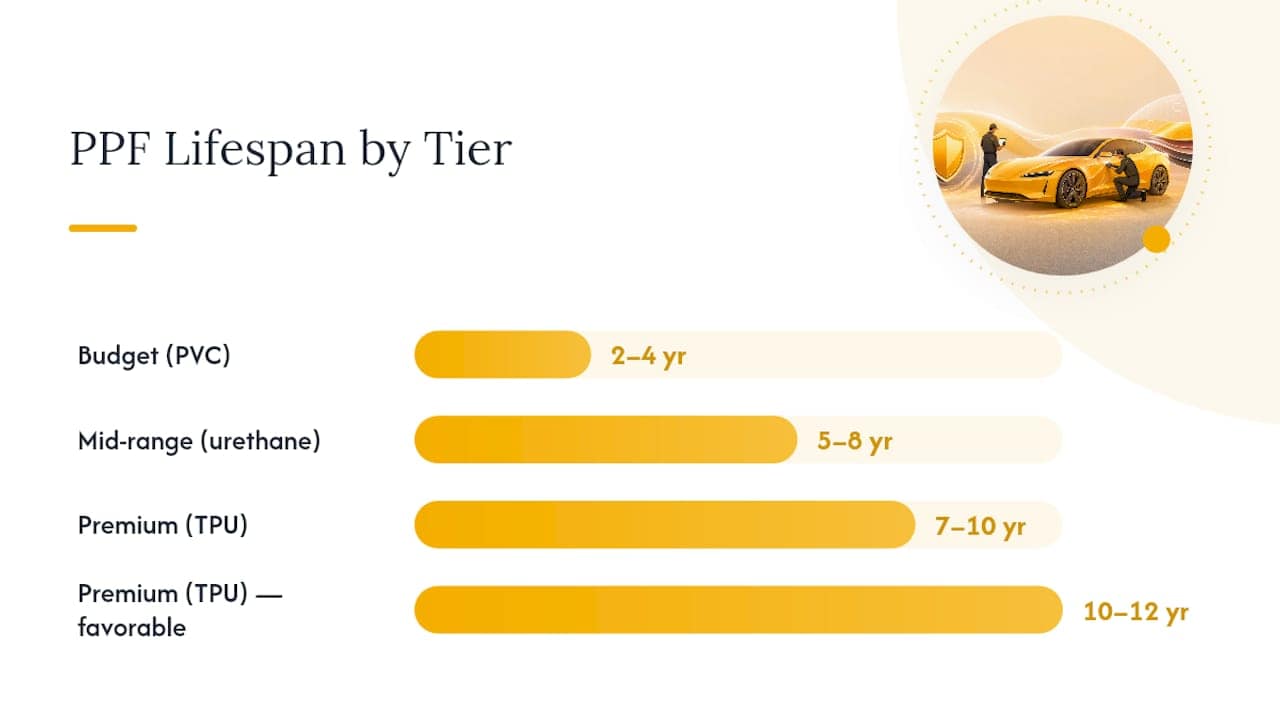
Budget PVC films tend to yellow within 2 to 4 years, especially on sun-exposed hoods and mirrors. Mid-range urethane films typically hold clarity and self-healing for 5 to 8 years. Premium TPU films with ceramic-infused topcoats commonly run 7 to 10 years and, in favorable climates with good care, can push toward 10 to 12 years before they need replacing.
“End of life” rarely means the film falls off. More often it means the film is still doing its job of stopping chips, just no longer looking good while doing it. Signs to watch for:
Industry guides consistently place premium film lifespan around 7 to 10-plus years, with mid-range and budget tiers trailing behind on both durability and cosmetic aging.
Two vehicles with the same film can age completely differently. The film itself is only part of the story.
Film chemistry and thickness matter first. TPU (thermoplastic polyurethane) film flexes and self-heals better than older PVC formulas, and ceramic-infused topcoats resist UV yellowing longer. Thicker film generally resists rock chips better but can be marginally more prone to edge lift if the installer rushes the wrap.
Installation quality is the single biggest lever you control. A shop that wraps edges properly, preps the paint correctly, and installs in a climate-controlled bay produces film that resists lifting for years longer than a rushed job. Edge-wrapping technique alone measurably reduces early edge-lift failures compared to film that’s simply cut and butted at panel edges. That’s covered in more depth in how proper installation prevents permanent flaws.
Environment and how you drive shape the rest:
Pro Tip: Wait at least seven days after installation before washing the car, and skip automatic car washes with spinning brushes for the life of the film. Those first two habits alone prevent more premature edge lift than almost anything else you’ll do.
Run this quick inspection anytime the film is a few years old and starting to look tired.
Warranty length is one of the clearest signals of how confident a manufacturer is in its own film, but it’s not a promise about your specific driving conditions.
There are two separate warranties to understand. The manufacturer warranty covers material defects in the film itself, typically for 5 to 10 years on premium products. Our Calgary PPF warranty guide, for example, covers up to 10 years against yellowing, cracking, blistering, and delamination on its flagship product lines when the film is professionally installed. The installer warranty is a separate, usually shorter agreement covering workmanship, like edge lifting caused by poor prep work.
What’s typically covered:
What’s typically excluded:
Warranty coverage generally excludes damage from misuse or improper maintenance, which is why keeping photo documentation and receipts for maintenance products matters if you ever need to file a claim. Warranties are also often transferable to a new owner with proper registration, which can be a real selling point if you plan to sell the car later. For the specifics on filing a claim, see how PPF warranty coverage works and what to document.
The film does most of the work, but your maintenance routine decides whether it reaches the top or bottom of its expected range.
In the first week, avoid washing the car entirely and never direct a pressure washer at the film’s edges. The adhesive needs roughly seven days to fully cure, and early pressure at seams is a common cause of premature edge lift.
After that, wash by hand with a pH-neutral car shampoo and a soft mitt. Skip automatic tunnel washes with rotating brushes, which grind grit into the topcoat over time and dull the self-healing layer faster than hand washing ever would.
Ceramic coating over PPF is one of the highest-value additions an owner can make. It’s commonly reported to add 2 to 4 years to usable film life by protecting the topcoat from UV breakdown and making the surface easier to clean, which means fewer harsh washes over the film’s lifetime. Partner guidance on keeping ceramic coating in top condition covers the upkeep side in more detail.
Pro Tip: Set a calendar reminder for an annual film inspection, even if nothing looks obviously wrong. Catching edge lift or early yellowing in year 4 instead of year 7 gives you time to plan a staged replacement instead of an emergency one. Full routines are laid out in PPF maintenance that keeps film clear.

Removal risk is low on healthy factory paint, since quality film pulls away cleanly without lifting clear coat. Risk climbs on panels that were previously repainted or repaired, where clear coat can be thinner or less adhered.
Because of that variance, many owners choose staged replacement instead of redoing the whole car at once:
That approach lines up with the cost logic covered in whether PPF is worth it and when to buy: staged refreshes on the panels that take the most damage often make more financial sense than a full strip-and-redo before it’s actually needed.
Practical experience backs up the ranges above. The PPF Company brings over 30 years of combined experience installing paint protection film in Calgary, and that hands-on exposure to films aging under real winters, road salt, and daily driving is exactly where lifespan estimates get tested against reality.
Self-healing technology performs differently panel to panel depending on sun exposure and wash habits, which is why installers emphasize inspection over guesswork. Customers have credited the company with competitive pricing and consistent service quality, which matters when a film’s real-world life depends as much on the install as the product. The company’s own breakdown of PPF cost, lifespan, and maintenance and its warranty coverage and claims process both echo the same pattern covered here: installation quality and maintenance routine decide where a given vehicle lands in its film’s expected range. Their maintenance guidance reinforces the same wash and inspection habits outlined above.
Daily commuters and highway drivers should lean toward the shorter end of the range and budget for front-panel refreshes every 5 to 7 years. Collectors and garage-kept owners can often stretch premium film past 10 years. Resale-focused owners get the most value from replacing high-impact panels just before selling, since fresh film reads as diligent upkeep to a buyer.
If you’re trying to figure out where your film actually stands, the answer isn’t a guess. It’s an inspection. Professional installers provide installation services, maintenance plans, and assistance with warranty claims when defects occur, helping customers navigate warranty details.
Booking a hands-on inspection is the fastest way to know whether your film has years left or is due for a staged refresh on the panels that take the most abuse. The team can check edges, test self-heal response, and flag anything worth documenting for a warranty claim before it becomes a bigger issue. If you’re weighing ceramic coating as a way to stretch your film’s remaining years, that’s worth discussing at the same visit. Start with the PPF maintenance guide to see what a tailored care routine looks like, then book an inspection to get a straight answer on your specific vehicle.
For manufacturer-specific warranty language, our Calgary PPF warranty guide spells out exact coverage terms. 3M’s warranty resources offer a second manufacturer example worth comparing. For lifespan drivers and film chemistry detail, the GrandPrix247 guide and YW Film’s breakdown both go deeper into testing and installer practices.
Most owners replace budget film every 2 to 4 years, mid-range film every 5 to 8 years, and premium TPU film every 7 to 12 years, often staging high-impact panels first.
PPF can yellow over time, lose self-healing ability with age, and requires careful washing to avoid edge lift; poor installation also raises the risk of early bubbling or peeling.
Not realistically. Even premium TPU film with ceramic-infused topcoats tops out around 10 to 12 years under good conditions, and most owners replace high-impact panels well before that mark.
Film at the 10-year mark, if it’s premium quality and well maintained, may still be intact but usually shows some yellowing, reduced clarity, and slower self-healing, making it a candidate for replacement rather than a failure risk.