

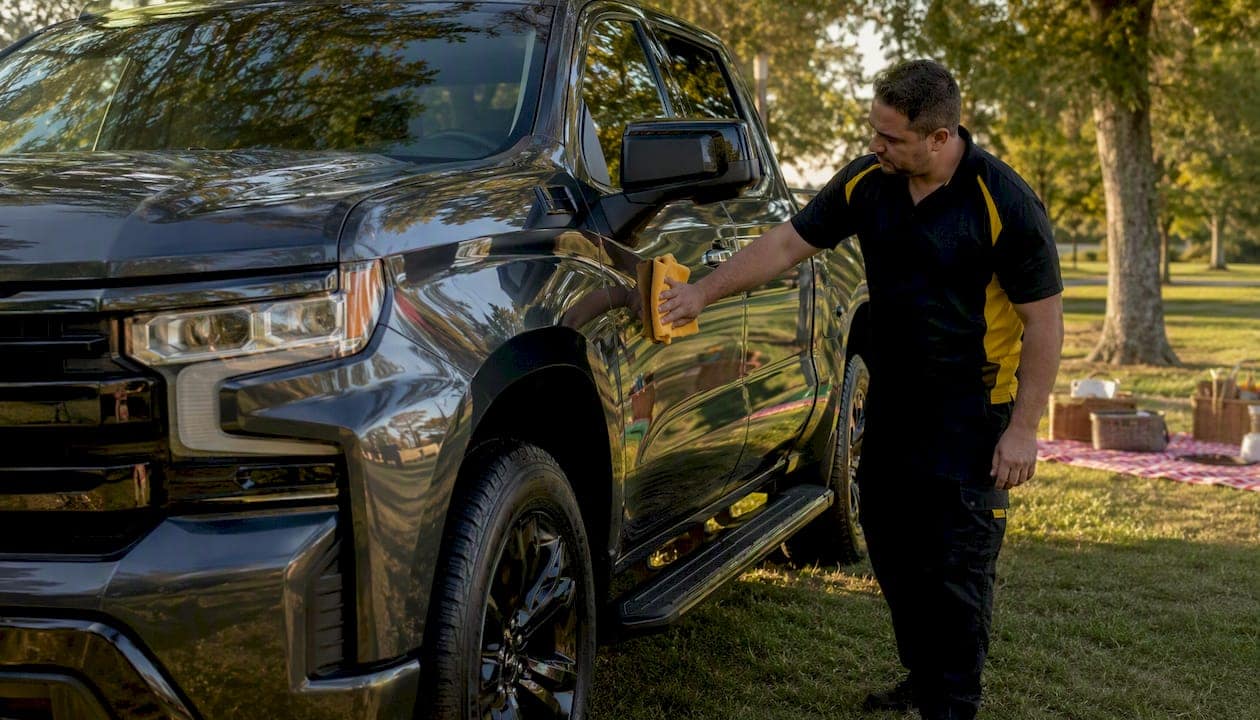
PPF is worth it for most truck owners, and the best starting point is a full front package plus rocker panels. That combination covers the panels that take the most punishment on virtually every truck, whether you’re hauling on the highway or running gravel roads. Budget $2,800–$4,500 for full front plus rocker panels on a full-size pickup. For daily drivers, moderate thickness film is the standard; if you tow regularly or go off-road, choose a thicker film on the rockers and bumper.
Priority coverage by use case:
Cost ballpark: partial front is $800–$1,500; full front is $2,000–$3,500; full front plus rockers is $2,800–$4,500; full body is $6,000–$12,000+ depending on cab size and trim.
Paint protection film is a clear polyurethane layer bonded directly to your truck’s paint. It acts as a sacrificial barrier, absorbing the kinetic energy of rock chips, sand abrasion, and road debris before any of it reaches the clear coat. When a stone hits PPF, the film deforms and then, with self-healing technology, returns to its original shape with the help of heat from the sun or warm water.
That is fundamentally different from what a ceramic coating does. Ceramic coatings create a hydrophobic, chemically resistant surface that repels water, bird droppings, and UV rays. They do not absorb impact. A rock chip will go straight through a ceramic coating and into your paint. PPF stops the chip; ceramic coating makes the surface easier to clean and slows UV degradation on panels that aren’t wrapped.
Common truck zones where PPF earns its keep: the full hood and front bumper (forward-facing debris), rocker panels (your own tire spray), and tailgate edges (loading and unloading contact).
Trucks take a different kind of abuse than sedans, and the geometry makes it worse. A taller ride height and wider stance mean more exposed surface area facing oncoming debris. Add a trailer hitch and suddenly the rear quarters are catching gravel thrown by the trailer’s tires at highway speed.
Truck-specific hazards that PPF addresses:
For high-trim trucks, the financial case is straightforward. A Platinum F-150 or a Denali 1500 carries a significant resale premium, and chips and scratches erode that premium fast. PPF preserves the paint condition that justifies the asking price when you sell. For work trucks, the ROI is different but still real: a truck that looks maintained holds its value better at fleet disposal or private sale than one with a sandblasted hood.
Owners who tow or use unpaved roads consistently underestimate how much debris their own tires throw at the rocker panels. That’s the panel most people skip, and it’s usually the one that looks worst at the three-year mark.
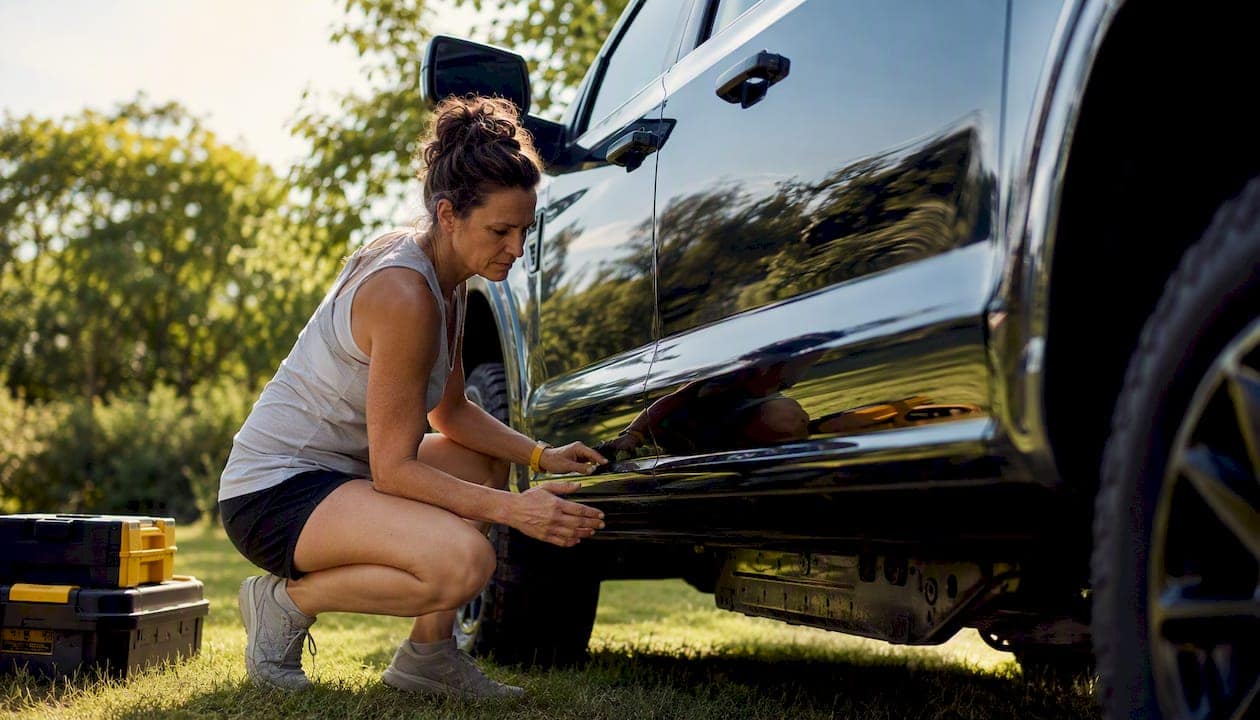
Most installers offer five standard packages for trucks. The right one depends on how you actually use the vehicle, not on what looks impressive on a spec sheet.

| Package | Panels Covered | Best For | Typical Price Range |
|---|---|---|---|
| Partial front | Bumper + partial hood | Budget-conscious daily highway drivers | $800–$1,500 |
| Full front | Hood, fenders, bumper, mirrors, headlights | Most daily drivers; best-value baseline | $2,000–$3,500 |
| Full front + rockers | Above + rocker panels | Gravel roads, ranch use, light towing | $2,800–$4,500 |
| Towing package | Full front + rockers + rear quarters | Frequent towers, fifth-wheel, gooseneck | $3,500–$6,000 |
| Full body | All exterior panels | High-value trucks, show trucks, long-term keepers | $6,000–$12,000+ |
Recommended starter package for most trucks: full front plus rocker panels. It covers the two highest-impact zones and leaves budget room to add rear quarters later if your towing frequency increases.
One coverage area that delivers outsized value for trucks that load and unload cargo regularly: bed rail strips and tailgate-top film. Full bed PPF, on the other hand, rarely makes sense for an actively used bed. A spray-in liner handles that abuse far better than film, which can lift under heavy repeated contact.
Thickness is measured in mils (thousandths of an inch). The choice affects both protection level and how the film looks on the panel.

| Thickness | Best Application | Trade-offs |
|---|---|---|
| 6 mil | Light-duty cars, interior trim | Minimal impact resistance; not recommended for trucks |
| 8 mil | Hood, fenders, doors on daily drivers | Good optical clarity; standard for most installs |
| 10–12 mil | Rockers, bumpers, off-road trucks | Better energy dissipation; slightly harder to install cleanly |
| 13+ mil | Heavy construction, serious off-road | Maximum protection; visible thickness on some colors |
Experienced installers mix thicknesses strategically: 8 mil on the hood and fenders for optical clarity, 10–13 mil on the rockers and bumper where impact resistance matters more than perfect optics. That approach gives you the best of both without compromising either.
Finish options go beyond clear gloss. Matte and satin finishes can change the look of a truck without paint, and color-change PPF lets you shift the vehicle’s color entirely while protecting the original paint underneath. If you’re considering a full-body color change, vinyl wrapping is a related option worth comparing.
Manufacturer technology to ask about:
XPEL ULTIMATE PLUS is one of the most widely specified films in the industry. It uses a proprietary top coat that self-heals light scratches and swirl marks with heat, and it carries a 10-year manufacturer warranty against yellowing, cracking, and delamination. Ask your installer if they are an authorized XPEL dealer.
MotoShield Pro offers films in multiple thickness options including heavy-duty variants suited to off-road and work truck applications. It’s worth asking about for rockers and bumpers where you want maximum impact resistance.
Pro Tip: Ask your installer specifically whether they plan to use bulk film or precut kits on your hood and bumper. Precut kits can create tension marks and visible seams on modern trucks with pronounced curves. Experienced shops often prefer bulk application on contoured panels.
Trucks cost more to wrap than sedans because the panels are larger, the geometry is more complex, and fender flares, factory sensors, and running boards all add labor time. A full-size pickup requires significantly more film and more installation hours than a compact car.
Price ranges for common packages (full-size trucks):
The primary factors that move a quote up or down: coverage area (more panels = more cost), film brand and thickness (premium films cost more per square foot), vehicle trim complexity (flares, factory sensors, and running boards add labor), and the installer’s experience level and warranty terms.
Quote checklist — what a written estimate should include:
Never accept a quote priced purely per square foot without a named panel list. That pricing structure makes it easy to omit panels you assumed were included.
The process has more steps than most truck owners expect, and rushing any of them creates problems that show up months later.
Typical timelines:
Post-install care for the first week:
Pro Tip: Schedule PPF installation before your first long road trip, not after. The drive home from the dealership is statistically the highest-risk period for rock chips on a new truck.
These two products solve different problems. PPF absorbs physical impact; ceramic coating creates a hydrophobic, UV-resistant surface layer. One does not replace the other.
| Feature | PPF | Ceramic Coating |
|---|---|---|
| Impact protection | Yes — absorbs rock chips and abrasion | No — chips go through to paint |
| Hydrophobic surface | Moderate (top coat) | Excellent |
| UV protection | Moderate | Strong |
| Self-healing | Yes (heat-activated, on quality films) | No |
| Lifespan | 7–10 years | 3–5 years (varies by grade) |
| Best for | High-impact zones: front, rockers | Unwrapped panels, full-body maintenance |
The most practical combination for trucks: PPF on the front and rockers, ceramic coating on the remaining panels. The PPF handles the debris; the ceramic coating makes every other panel easier to wash and protects against UV fading. Ppf offers both ceramic coating in Calgary and PPF installation, so you can get both done at the same appointment.
When not to pair them: if budget is tight, prioritize PPF on the impact zones first. A ceramic coating on top of PPF is a nice upgrade but not a requirement.
With professional installation and proper care, PPF typically lasts 7–10 years. UV exposure, road salt, and heavy debris contact are the main factors that shorten that window. A truck used daily in a northern climate with heavy winter salt will see more wear than the same truck in a mild, dry region.
Maintenance routine that extends film life:
What a solid warranty covers:
What typically voids a warranty: using abrasive polishes on the film, applying wax with petroleum solvents, or damage from a collision. Read the warranty document before you sign, not after.
PPF is not maintenance-free, and a bad install creates problems that are expensive to fix.
Edge lifting is the most common issue. It happens when film edges aren’t properly tucked into panel gaps or when the adhesive wasn’t given enough cure time. Prevention: choose an installer who tucks edges rather than terminating them on the surface, and follow the post-install care instructions strictly.
Visible seams show up most often with precut kits on highly contoured hoods and bumpers. The pattern doesn’t conform perfectly, leaving a visible line. Bulk application by an experienced hand eliminates most of this.
Yellowing on older films was a real problem; modern films from reputable manufacturers have UV-stable top coats that resist yellowing for the warranty period. If an installer is offering a film you can’t identify by brand and product name, that’s a red flag.
Optical mismatch on older paint happens when the truck’s clear coat is already faded or oxidized. PPF will look noticeably different from the surrounding paint. Paint correction before installation solves this, but it adds cost. On a truck with heavily weathered paint, the honest answer is sometimes that PPF isn’t the right investment until the paint is restored.
Bed protection limitations: full bed PPF peels under the repeated impact and dragging of cargo. Bed rail strips and tailgate-top film are worth it; full bed film is not for an actively used truck bed. A spray-in liner is the right tool for that job.
Pro Tip: When getting quotes, ask each installer specifically how they handle rocker panel edges. An installer who guarantees tucked edges on rockers is telling you something important about their process.
The installer matters more than almost any other variable. A premium film applied badly will fail faster than a mid-grade film applied by a skilled hand.
Questions to ask every installer:
Red flags to walk away from:
Comparison criteria:
Pro Tip: Ask whether the installer uses a mixed-thickness strategy. An installer who applies the same mil across every panel is either cutting corners or doesn’t know the technique. The best shops run 8 mil on flat panels and 10–13 mil on rockers and bumpers.
The clearest pattern across installer practice and owner experience: most truck owners protect too little, too late. They skip the rockers, skip the rear quarters, and then spend money on spot repairs at year three.
The research-backed recommendation for most trucks is to start with full front plus rocker panels. That covers the two zones that account for the majority of paint damage on a typical pickup. If you tow more than occasionally, add the rear quarters at the same time rather than as a retrofit.
On film technology: self-healing films from established manufacturers have made a real difference in long-term appearance. The top coat on quality films like XPEL ULTIMATE PLUS recovers from light swirl marks with heat, which means a truck that gets washed regularly will look better at year five than one wrapped in a basic film.
Certified installers and manufacturer-backed warranties are not just marketing language. They provide actual recourse if the film yellows or lifts prematurely. An installer who can’t tell you which manufacturer backs their warranty is one to avoid.
Ppf brings over 30 years of combined experience to PPF installations, serving truck owners in Calgary and Winnipeg with a focus on proper prep, correct film selection, and installations that hold up under real use. You can review past truck installations to see the quality of work before booking.
Full front plus rocker panels is the right starting package for most truck owners, with 10–12 mil film on the high-impact zones and a certified installer who provides a written, manufacturer-backed warranty.
| Point | Details |
|---|---|
| Recommended starter package | Full front plus rocker panels covers the two highest-damage zones for $2,800–$4,500 on a full-size truck. |
| Thickness rule of thumb | Use 8 mil on flat panels for clarity; step up to 10–12 mil on rockers and bumpers for impact resistance. |
| Lifespan expectation | Professional installation with proper maintenance delivers 7–10 years of protection. |
| Installer checklist | Demand a written warranty, a named film brand and mil, and a panel-by-panel quote before signing. |
| Ppf service | Ppf installs PPF for truck owners in Calgary and Winnipeg, with ceramic coating available to pair on unwrapped panels. |
Most truck owners spend $50,000–$80,000 on a new pickup and then hesitate at a $3,000 PPF package. That math doesn’t hold up. The paint on a high-trim truck is part of what you paid for, and it’s the first thing a buyer looks at when you go to sell.
What I find more interesting is the coverage decision people get wrong most often: they protect the hood and skip the rockers. The hood is visible and feels important. The rockers are low and easy to ignore until they look like a sandblasted mess at year four. If you drive any unpaved road, tow anything, or live somewhere with winter road salt, the rockers are the panel you cannot afford to skip.
The other underrated move: book the install before your first long drive, not after. A new truck driving off the lot unprotected is the highest-risk moment in its life. One highway trip can put chips in the hood that you’ll be looking at for the next decade.
…
Ppf is the PPF installer truck owners in Calgary and Winnipeg turn to when they want the job done correctly the first time. With over 30 years of combined team experience, Ppf uses advanced self-healing film technology and applies it with the kind of prep work that determines whether a wrap lasts five years or ten. The focus is on getting the coverage right for how you actually use your truck, not just wrapping the easy panels.
Ppf also offers ceramic coating in Winnipeg to pair with PPF on unwrapped panels, so you can protect the entire vehicle in one visit. If you’re ready to get a written quote with a named film, a panel list, and a real warranty behind it, book your truck’s PPF installation with Ppf today.
Yes, especially for high-trim trucks, frequent towers, and anyone driving on gravel or unpaved roads. PPF protects against rock chips, road salt, and debris that ceramic coatings cannot stop, and it preserves resale value over the truck’s life.
Typical ranges for full-size trucks: full front runs $2,000–$3,500; full front plus rocker panels runs $2,800–$4,500; full body coverage runs $6,000–$12,000 or more depending on cab size and trim complexity.
With professional installation and proper maintenance, PPF typically lasts 7–10 years. UV exposure, heavy road salt, and frequent off-road debris contact are the main factors that shorten that range.
The main risks are edge lifting from poor installation, visible seams from precut kits on contoured panels, and optical mismatch on trucks with faded or oxidized paint. Choosing a certified installer with a written manufacturer-backed warranty eliminates most of these problems before they start.

Calgary
Winnipeg
Calgary
Winnipeg