

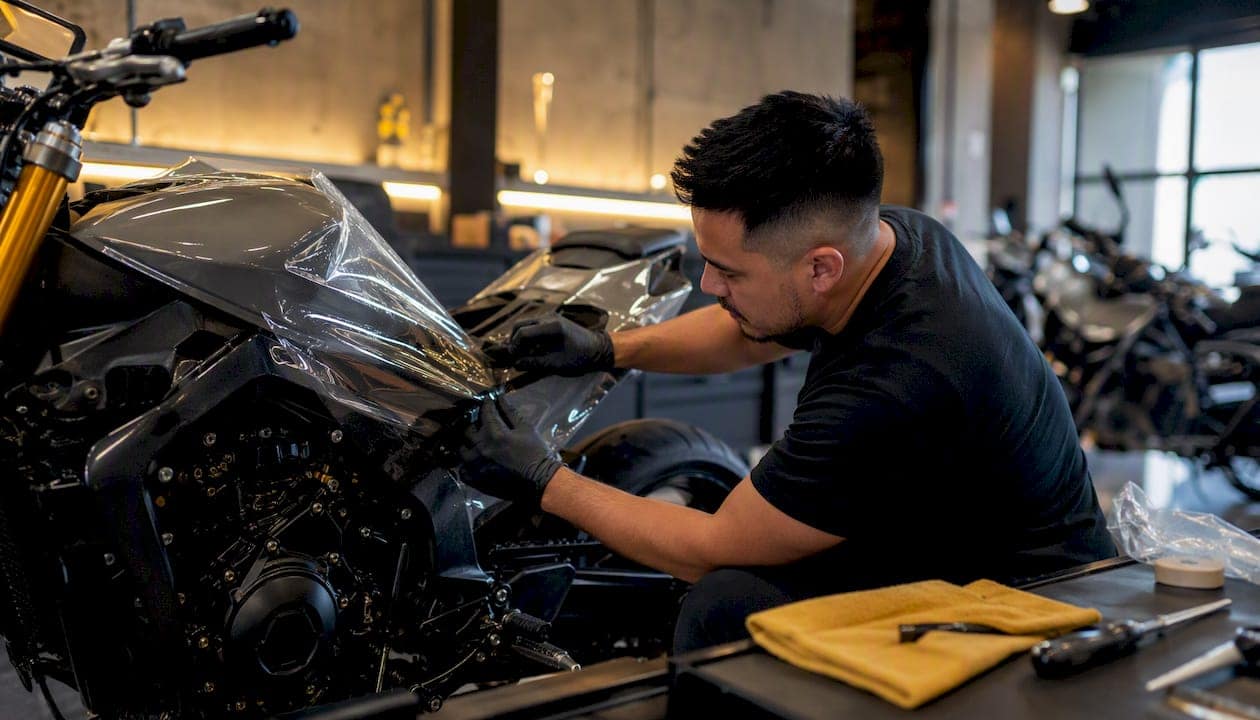
Paint protection film is worth it for most motorcycle owners, and the best place to start is the tank and front-end coverage. For everyday street riders, a tank-only or front-fairing package delivers the strongest return on cost. If you log serious highway miles, ride track days, or own a high-value sportbike, full-fairing coverage makes more sense.
Here is a quick price frame to set expectations:
If you ride highways regularly or hit gravel on off-ramps, prioritize the front fairing leading edges and tank first. Garage-kept bikes with low annual mileage can often get away with tank-only film and a ceramic coating on the rest.
The right coverage level depends on how you ride, what the bike is worth, and your budget. Most installers offer four tiers.
Tank-only is the most popular starting point. The tank takes knee scuffs, zipper scratches, belt buckles, and fuel spills constantly. A tank-only install typically starts around $250–$350 for entry-level DIY kits and $300–$500 for professional work.
Tank + front fairing adds the leading edges of the upper and lower fairings, the headlight surround, and sometimes the fork lowers. This is the sweet spot for highway commuters: it covers every surface that takes direct rock and bug impact.
Partial coverage expands to fenders, mirrors, swingarm, and tail sections. Good for touring bikes and ADV riders who see varied road surfaces.
Full fairing/full bike wraps every painted panel. This is the right call for track bikes, show bikes, and anything with a replacement fairing cost that runs into thousands of dollars.
On kit format, you have two choices:
Pre-cut kits reduce installation error on complex fairings. For most production bikes, they are the better choice.
The film brand matters more than most riders realize. Here is what to evaluate and the major names you will encounter:
Evaluation criteria:
Major film brands used on motorcycles:
XPEL is one of the most widely recognized names in the PPF market. XPEL offers model-specific precut patterns through its DAP (Design Access Program) and backs its film with a manufacturer warranty. Ask any installer for their authorized XPEL status before booking.
3M VentureShield has been in the market for decades and is known for durability and optical clarity. 3M’s authorized installer network is extensive, and the brand’s longevity means warranty claims are well-documented.
STEK has built a strong reputation for its DYNOshield and DYNOmatte lines, particularly among enthusiasts who want a stealth/matte finish. STEK film is known for strong self-healing performance and good conformability on curved surfaces.
Lamin-x is a popular choice for headlight and taillight tint film, and the brand also offers protective film for painted surfaces. It is widely available as a DIY option for riders who want to protect specific panels without a full professional install.
Eazi-Grip focuses specifically on motorcycles, offering tank grips and paint protection kits designed for common models. Their motorcycle-specific focus means patterns are often well-fitted for popular bikes.
Pro Tip: Always ask the installer to show you the film’s published warranty document before work begins. “Lifetime warranty” claims vary wildly between manufacturers. Know exactly what is covered: manufacturer defects, yellowing, delamination, and whether impact damage is included.
| Factor | DIY Precut Kit | Professional Install |
|---|---|---|
| Best for | Simple panels, tank-only, flat surfaces | Full fairing, compound curves, high-value bikes |
| Finish quality | Good on flat areas, variable on curves | Consistent edge tucks, clean finish |
| Installation approach | Self-install with included tools | Climate-controlled bay, panel removal when needed |
| Price | Lower upfront ($150–$400 for kit) | Higher labor cost, better long-term result |
| Warranty | Kit warranty only; labor not covered | Manufacturer + installer warranty when authorized |
| Self-healing | Yes, if film includes topcoat | Yes, same film quality |
DIY kits work well for tank protection and simple flat panels. The risk shows up on complex fairings: compound curves require heat-forming and precise edge tucks that are genuinely difficult without experience. Bubbles, lifted edges, and poor conformity on a $2,000 fairing cost more to fix than the labor savings justify.
Professional installers working in climate-controlled bays often remove panels entirely for access. Superbike and fully-faired installs specifically require higher-conformability TPU film and experienced technique to prevent lift and wrinkling. That is not a sales pitch for pros; it is just the geometry of a modern sportbike.
One more thing on warranties: some film manufacturers require authorized installer status to activate the manufacturer warranty. A DIY install may leave you with only the product warranty, not the full coverage a professional install would provide.
| Coverage Package | Typical Cost Range | Expected Lifespan |
|---|---|---|
| Tank-only | $300–$500 | 5–10 years |
| Tank + front fairing | $500–$800 | 5–10 years |
| Partial coverage | $800–$1,500 | 5–10 years |
| Full fairing/full bike | $1,500–$2,500+ | 5–10 years |

Prices vary based on bike size and complexity, heat-resistant film requirements near exhausts, color-matched or matte finish options, and local labor rates. Exotics and large touring bikes with extensive bodywork regularly exceed $3,000 for full coverage.
Quality motorcycle PPF typically lasts 5–10 years. The range reflects exposure: a bike stored indoors and ridden seasonally will see film closer to the 10-year end; a daily commuter in a hot, sunny climate may see degradation closer to 5–7 years.
Compare that against the cost of a single repaint. A professional respray on a motorcycle tank alone can run $500–$1,000 or more depending on paint complexity. Full fairing repaints on sportbikes regularly exceed $2,000. PPF pays for itself the first time it stops a rock chip from requiring a color-matched touch-up.
Routine maintenance is straightforward. Wash with a pH-neutral soap, avoid automatic car washes with rotating brushes, and dry with a clean microfiber cloth. After a fresh install, give the film a 24–72 hour curing window before washing or mounting tank bags.
Self-healing works through heat activation. Light swirl marks and minor surface scratches disappear when the film warms up, either from direct sunlight on a warm day or a brief pass with a heat gun set to low. Pour warm water over the area and watch the marks fade in real time. What will not self-heal: deep gouges that cut through the topcoat, or marks that have been there long enough to set permanently.

Pro Tip: For self-healing to work reliably, the film needs to reach roughly 140–160°F. On a cool day, a heat gun works faster than sunlight. Keep the gun moving and do not hold it in one spot.
When to repair versus replace: small edge lifts and isolated cuts can often be patched with a matching piece of film. If the film has yellowed across a large panel, delaminated from the surface, or taken multiple hard impacts in the same zone, replacement is the better call. Trying to patch heavily degraded film rarely looks clean.
Pair PPF on high-impact areas with a ceramic coating on remaining painted panels for hydrophobic protection and easier cleaning across the whole bike.
Before and after the job, a credible installer provides specific documentation and deliverables. Here is what to expect from a quality shop:
Red flags: no written warranty, reluctance to show prior motorcycle installs, pressure to use an unbranded or undocumented film, and no mention of prep steps. The PPF Company brings over 30 years of combined experience to every install and provides the documentation and authorized-installer credentials that protect your investment.
PPF on a motorcycle’s tank and front-end delivers the strongest protection-per-dollar for most riders, with quality film lasting 5–10 years and full-bike coverage costing $1,500–$2,500 for most production bikes.
| Point | Details |
|---|---|
| Start with tank and front fairing | These two zones take the most rock, bug, and contact damage on any street bike. |
| Budget by coverage level | Tank-only coverage typically costs $300–$500; full fairing/full bike coverage often costs $1,500–$2,500, with exotics exceeding $3,000. |
| Film typically lasts 5–10 years depending on use and environment. | Lifespan depends on exposure, climate, and whether the bike is stored indoors. |
| Authorized installers matter | Manufacturer warranty activation often requires an authorized installer, not just any shop. |
| Ppf combines PPF with ceramic coating | Ppf’s approach pairs film on high-impact zones with ceramic coating on remaining panels for full-bike protection. |
Most riders think about PPF the way they think about paint sealant: something you do once to keep the bike looking new. That framing undersells what the film actually changes about how you ride.
When your tank and fairings are protected, you stop flinching on gravel-strewn on-ramps. You ride highways without mentally cataloging every chip. You park at rallies without anxiety. That shift in riding confidence is real, and it compounds over miles.
The economic case is straightforward: a single color-matched fairing repaint on a modern sportbike costs more than a full PPF install on the same panels. But the less-discussed payoff is resale. Original paint in excellent condition commands a premium that repainted panels simply do not. Buyers notice overspray, color-match variance, and texture differences immediately. PPF keeps the factory finish intact under the film, which means when you sell, you are selling original paint.
The strongest long-term setup pairs PPF on the tank and leading edges with a ceramic coating on all remaining painted surfaces. The ceramic layer adds UV resistance, hydrophobic properties, and easier cleaning to every panel that does not have film. Together, they cover every failure mode: physical impact on the high-risk zones, UV and chemical degradation everywhere else.
One thing riders consistently underestimate: the front fairing leading edges. The tank gets all the attention because it is visible and tactile, but the upper fairing takes the full force of highway debris at speed. Protecting it costs relatively little added to a tank install, and leaving it bare on a bike you ride hard is a decision you will notice within a season.
For deeper reading on film specifications, warranty terms, and model-specific pattern availability:
Riders who want the job done right the first time skip the DIY kit gamble on complex fairings. Ppf brings over 30 years of combined experience to every vehicle protection install, using precision-cut patterns and authorized film to deliver clean edges and manufacturer-backed warranties.
The difference between a shop that does cars and a team that genuinely understands vehicle protection film is visible in the edge tucks and the documentation they hand you afterward. Ppf pairs PPF installation with ceramic coating options so your entire bike is covered, not just the panels under film. Serving Calgary and Winnipeg, Ppf offers the full protection stack: film on high-impact zones, ceramic on the rest, and written warranty terms you can actually read.
Ready to protect your bike’s paint before the next riding season? Request a quote for your motorcycle and get a coverage recommendation matched to how you actually ride.
Tank-only motorcycle PPF typically runs $300–$500; tank plus front fairing runs $500–$800; partial coverage is $800–$1,500; full-fairing coverage costs $1,500–$2,500 for most production bikes, with exotics exceeding $3,000.
Yes, for most riders who log regular highway miles or own a high-value bike. PPF prevents rock chips, bug damage, and contact scuffs, and keeps original paint intact for resale value.
XPEL, STEK, and 3M VentureShield are among the most widely used and warranted films for motorcycle protection. The best choice depends on your finish preference (gloss vs. matte), installer authorization, and whether model-specific precut patterns are available for your bike.
Quality motorcycle PPF lasts 5–10 years depending on climate, UV exposure, and how the bike is stored. Indoor-kept bikes ridden seasonally tend to see film closer to the 10-year end of that range.
Yes, for simple panels like the tank using a precut DIY kit. Complex fairings with compound curves are significantly harder to install cleanly without professional tools and experience, and a poor DIY install on expensive bodywork can cost more to fix than the labor savings.

Calgary
Winnipeg
Calgary
Winnipeg