
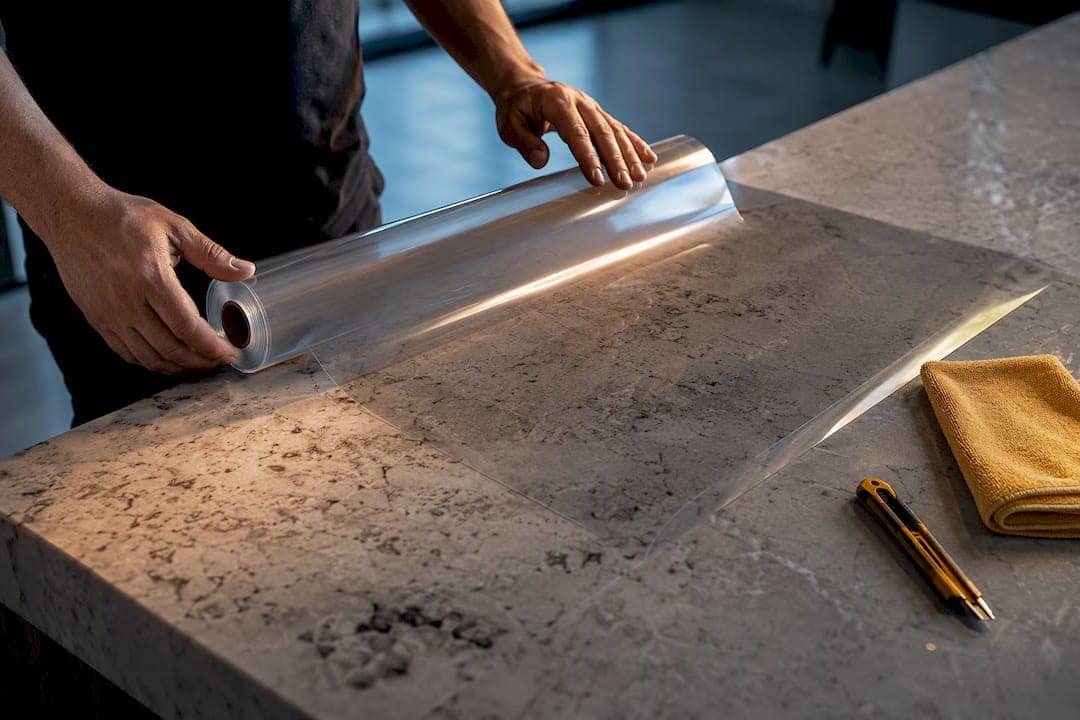
For a renovation, move, or countertop install, a temporary adhesive film is the right call and most jobs need nothing thicker than 2 to 3 mils. For long-term daily protection on stone, a professional-installed urethane film in the 5 to 8 mil range holds up far better and is worth hiring out. If you’re unsure which category your situation falls into, run a small patch test first or call an installer before committing to a full application.
TL;DR:
- Temporary polyethylene films in 2 to 3 mils are suitable for short-term protection during renovation or moving, but not for long-term daily use.
- Professional urethane PPF films measuring 5 to 8 mils provide much better durability and scratch resistance for stone countertops over multiple years.
- Adhesive chemistry, UV exposure, and surface type are critical factors that affect film performance and removal, especially on unsealed or porous surfaces.
- DIY application can work on simple, flat surfaces, but complex edges or seams require professional installation to ensure long-term protection.
- Proper maintenance involves gentle cleaning and prompt film replacement if bubbling, lifting, or yellowing occurs, with long-lasting protection mainly achieved through installer-backed urethane films.
Countertop protection film isn’t one product. It’s a category that splits into three distinct materials, and mixing them up is the single most common mistake homeowners make when shopping for one online.
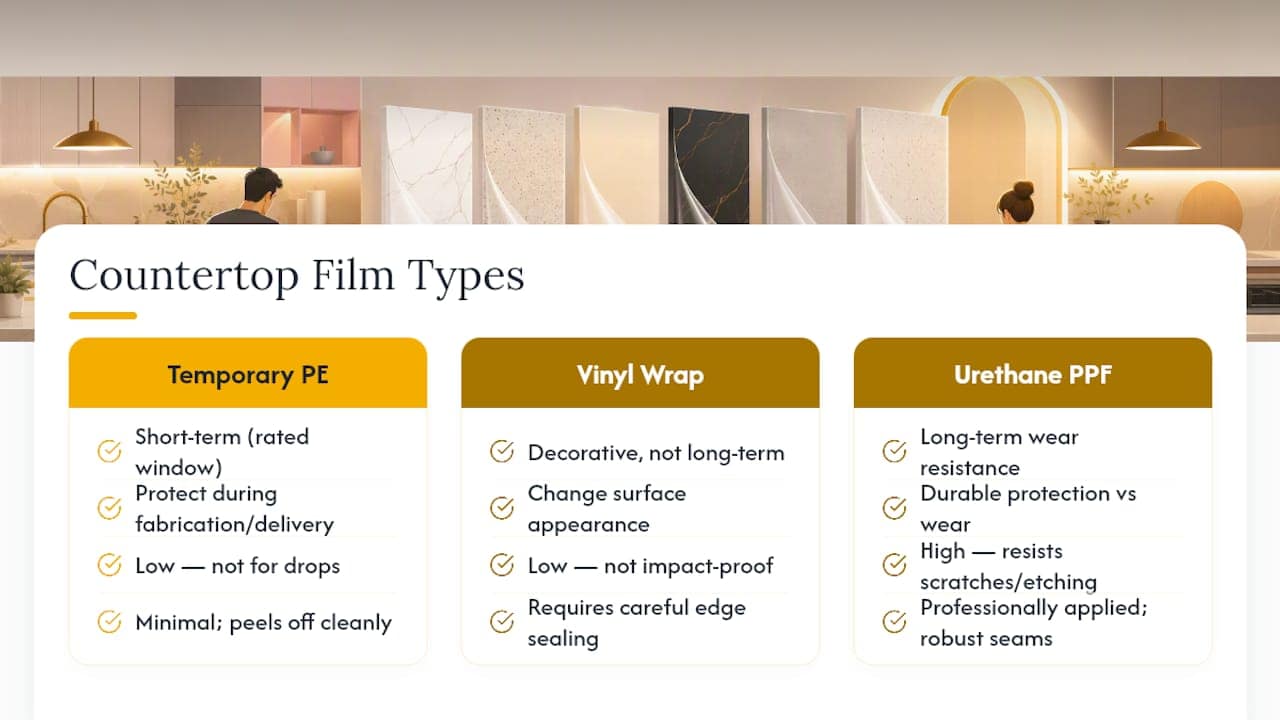
Temporary countertop protection film is a polyethylene sheet with a water-based acrylic adhesive, built for short-term jobs like fabrication, delivery, and renovation. Presto Tape describes it as designed to peel off cleanly without leaving residue, as long as it comes off within its rated window.
Vinyl countertop wraps are a different animal entirely. They’re decorative, meant to change the look of a surface rather than shield it from impact, and they require careful edge sealing to keep them from lifting at the seams. They’re not built to survive a dropped cast iron pan.
Urethane, PPF-style films are the heavy-duty option. These are the thick, self-healing films professionals apply for genuine long-term wear resistance against scratches, etching, and daily abuse, similar in concept to the paint protection film used on vehicles.
Thickness numbers on a product label tell you almost everything about how a film will perform, and most buyers skip right past them.
Adhesive chemistry matters just as much as thickness. Acrylic adhesives, common on temporary film, are formulated for medium tack and clean removal within a rated dwell time, often around 30 to 45 days according to suppliers like TapeManBlue. Push past that window and the adhesive can start to cure onto the surface, making removal messier.
Manufacturer spec check: 3M’s SPF6 line is rated at 6 mil, roughly 152 microns, which lands squarely in the professional-grade tier. That’s the benchmark worth comparing against when a listing just says “heavy duty” without a number attached.
UV exposure is the other variable nobody talks about enough. Films left in direct sunlight for extended periods, especially near a window-facing counter, can yellow or become brittle faster than the same film in a shaded kitchen. That’s less of an issue for a 30-day construction job and a bigger one for anything meant to stay down for years.
Not every stone or surface reacts the same way to adhesive, and this is where a lot of DIY projects go wrong.
Sealers and finishes can chemically interact with adhesive in ways that aren’t always obvious until removal day. A film pulled up too aggressively, or left down too long, can lift a sealer coat right along with it, leaving dull patches or a sticky residue behind. Surface Armor’s guidance on matching film and adhesive to the substrate applies directly here: the right film for granite isn’t automatically the right film for a honed marble finish.
Before covering an entire counter, test a small, inconspicuous section. Apply a patch, leave it for 24 to 48 hours, and check for discoloration, residue, or lifted sealant before committing to the full surface.
Pro Tip: When you’re not sure whether your sealant and a given adhesive will play nicely together, call the film supplier or a local installer before you buy. A five-minute question beats a ruined countertop finish.
Match the job to the product, not the other way around. Here’s the framework that keeps most people from wasting money on the wrong option:
Before you buy from any vendor, ask these four questions: What’s the rated dwell time? What adhesive type is used? What’s the recommended removal method? Does installation come with any warranty or backing? A vendor who can’t answer all four clearly is one to skip.
DIY application isn’t hard, but skipping steps is exactly how residue and lifting happen.
If film has been left down past its rated time and resists removal, isopropyl alcohol applied to a lint-free cloth usually softens residual adhesive without damaging most sealed surfaces. If it still won’t budge cleanly, stop. Forcing it risks pulling up sealant along with the film.
Professional installation looks nothing like the DIY version. Installers use computer-cut patterns and heat-forming to shape film precisely around sinks, seams, and curved edges, then seal those edges so moisture and debris can’t work their way underneath. That precision is exactly what makes long-term urethane PPF hold up for years instead of weeks.

Pro Tip: Keep a squeegee, a roll of lint-free cloths, and isopropyl alcohol on hand any time film goes down. Cheap tools now save you from a residue headache later.
Temporary films are built for a defined window, not a defined lifetime. Most are rated for up to 30 to 45 days before adhesive residue risk climbs. Installer-backed urethane PPF, by contrast, is designed for multi-year use, with actual longevity depending on the specific film and how well it’s maintained.
If more than a small section is compromised, replace the whole sheet rather than patching. Mismatched film ages differently and looks worse over time than a clean single layer.
Most of what’s written about countertop protection film treats it as a single product category. It isn’t. There’s a meaningful difference between a roll of construction film meant to survive a kitchen remodel and a professionally fitted urethane film meant to survive a decade of daily cooking, and treating them the same sets homeowners up for disappointment either way.
The PPF Company has spent over 30 years combined working with protective films, primarily on vehicles, using self-healing urethane technology and ceramic coatings that share the same underlying logic as high-durability countertop PPF, with thicker material, better adhesive engineering, and installation precision that a roll of tape from a hardware store simply can’t replicate.
On stone counters specifically, an installer-backed 5 mil film applied to marble delivers protection against etching and scratching that off-the-shelf temporary film was never designed to provide. The install process mirrors automotive PPF work: careful pattern cutting, edge sealing, and a maintenance handoff so the homeowner knows exactly how to care for the surface going forward.
That marble project is a useful case study precisely because marble is one of the most vulnerable stone surfaces in a kitchen. It etches from acidic spills, scratches easily, and shows wear faster than granite or quartz. A properly installed film changes that equation substantially. Anyone weighing a similar project can review the installer-backed marble countertop protection example or check maintenance routines for keeping installed film performing well over time.
The advice floating around online treats countertop protection film like a one-size-fits-all purchase decision, and that’s where most guides go wrong. The real decision isn’t “which film is best.” It’s “what is my counter made of, how long do I need protection, and how complex is the geometry I’m covering.”
A homeowner protecting a laminate counter during a two-week kitchen paint job has completely different needs than someone trying to keep a matte marble island scratch-free for the next ten years. Temporary film solves the first problem well and the second problem barely at all. That’s not a knock on temporary film, it’s just not what it’s built for.
The bigger blind spot in conventional advice is edges and seams. Flat sections of countertop are easy for anyone to cover. Sinks, mitered corners, and L-shaped layouts are where DIY jobs fail, because a slightly misaligned edge on a scratch-resistant film is worse than no protection at all, since it traps grit right where wear happens fastest. If your counter has any complex geometry and you want protection measured in years rather than weeks, that’s the point where hiring a professional stops being optional.
If you’ve read this far because a roll of construction-grade film feels too flimsy for a counter you plan to keep for years, that’s the right instinct. Some professional installers bring self-healing urethane technology and installer precision used on vehicle paint protection film to stone countertops, which means edge sealing, pattern-fitted coverage, and a finish built to outlast a DIY roll by years, not weeks.

That approach matters most on high-use surfaces like kitchen islands and marble counters, where etching and scratching happen fastest and a poorly sealed edge undoes the whole job. The PPF Company’s team applies the same carbon fiber protection film expertise that keeps automotive surfaces scratch-free for years to stone counters, backed by installation know-how rather than a guess-and-check approach. If your countertop is due for real, long-term protection, request a quote and get a surface assessment before your next spill becomes a permanent etch mark.
It depends on the timeline. Temporary polyethylene film with acrylic adhesive covers short-term jobs like renovations, while installer-backed urethane PPF in the 5 to 8 mil range is the better choice for years of daily protection on stone.
For construction and moving projects, yes. It’s inexpensive and prevents paint, dust, and debris damage during work that would otherwise risk the finish. For long-term daily use, professional-grade PPF delivers far more value per dollar over time than repeatedly replacing temporary film.
Yes. Urethane PPF, similar to the film used on vehicle paint, is applied by installers to stone counters like marble and granite for scratch and etch resistance that temporary film can’t match, using pattern-cut installation techniques fitted to the counter’s edges and seams.
For a film-based option, professionally installed urethane PPF outperforms temporary film and vinyl wraps on durability. If you’re weighing coatings versus film, a licensed installer can assess your specific stone type and recommend the right protective approach for your counter.