
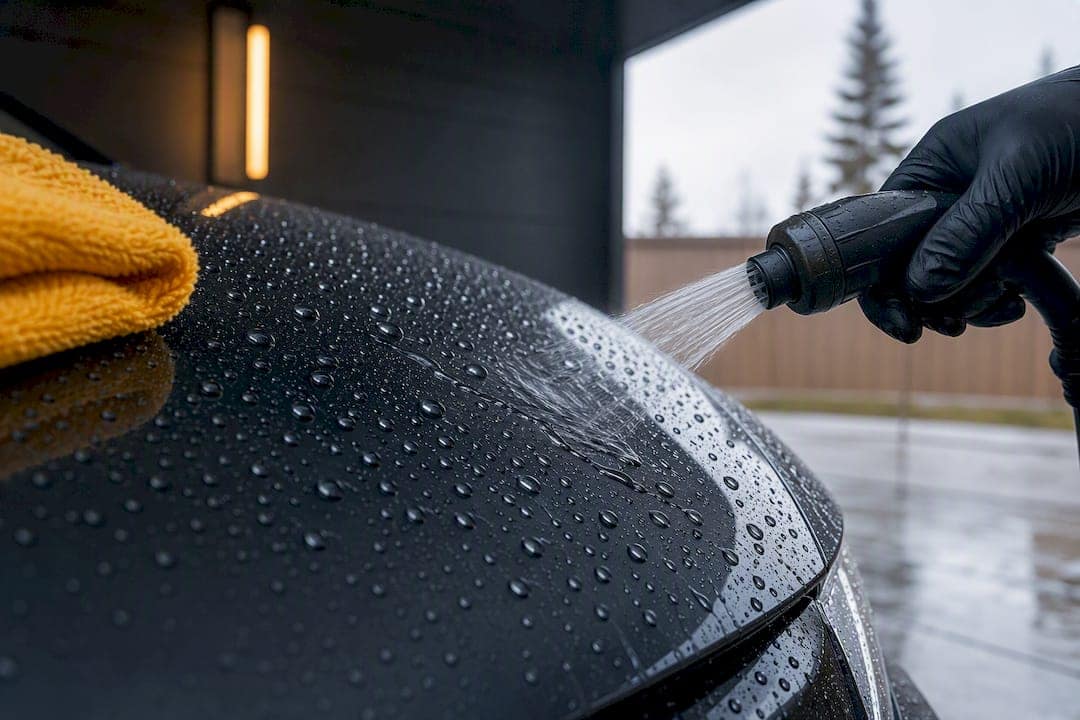
Yes, a healthy ceramic coating should bead water, and losing that behavior almost never means the coating has failed outright. It usually means the surface is masked by contamination or worn down by improper washing. The fix, in most cases, starts with a proper wash and a decontamination pass, not a full recoat. Only when beads stay flat and lazy after that should you think about paint correction or professional reapplication.
TL;DR:
- Contamination and improper washing are the most common causes of water not beading, not coating failure, and can often be fixed with proper cleaning.
- Water beading and sheeting behave differently, with sheeting being preferable for daily drivers to reduce mineral deposits and water spots.
- Fresh, well-cured coatings typically have a lower sliding angle, resulting in better water runoff and longer-lasting hydrophobic properties.
- Replacing a worn coating usually requires professional decontamination, correction, or reapplication, not just a booster or simple wash.
- Regular maintenance, including frequent washes every one to two weeks and boosters every three to six months, is essential for maintaining optimal water beading and coating performance.
Beading is water pulling itself into tight, round domes that sit on the paint until they roll off. Sheeting is water spreading into a thin film that slides away in a wave, leaving very little behind. Both are signs of a working hydrophobic surface, but they behave differently once the water starts evaporating.
Tight beads look dramatic in photos, and that’s exactly why detailers chase them. The tradeoff is that isolated beads sitting still on a hood in direct sun can concentrate minerals as they dry, raising the odds of etched water spots. Sheeting, by contrast, clears the panel faster and leaves less standing water to evaporate in place, which is why some installers actually prefer a slightly less “beady” coating on daily drivers.
The behavior that separates the two is sliding angle, meaning how much a panel has to tilt before a droplet starts moving. A few practical points worth knowing:
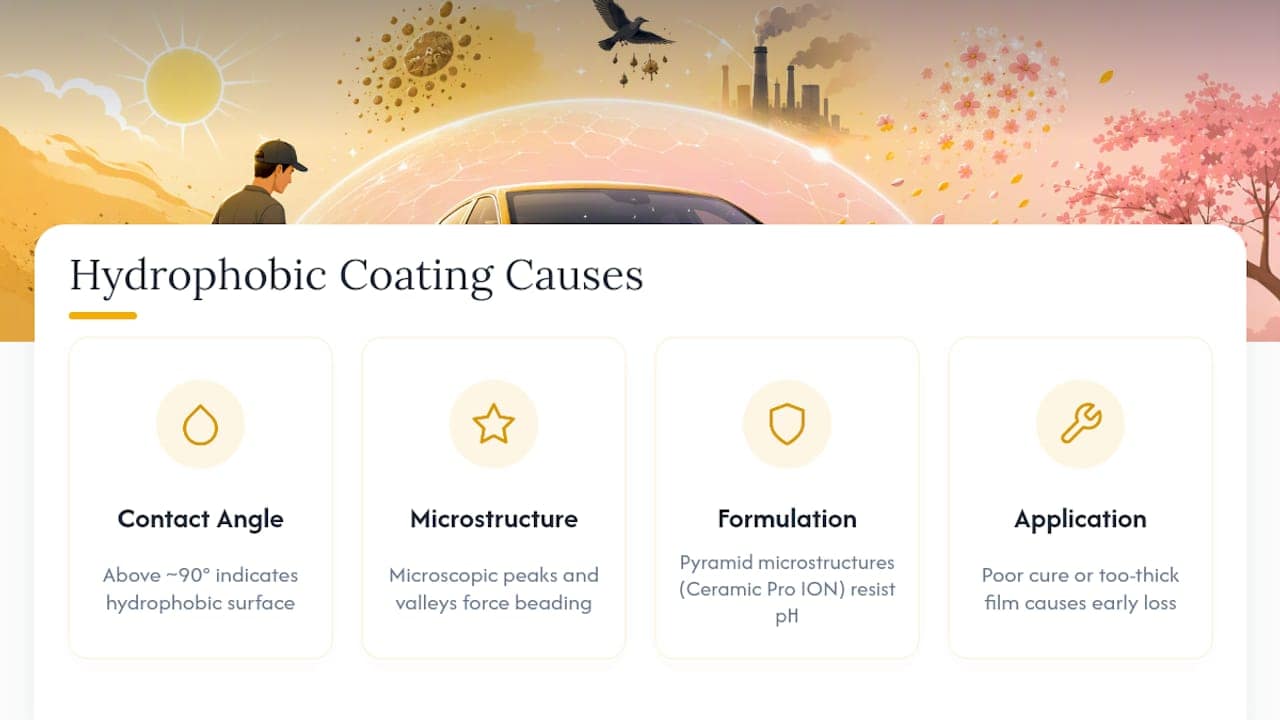
The easiest way to judge hydrophobicity without lab equipment is the contact angle: the angle a water droplet forms where it meets the paint. A contact angle above roughly 90 degrees is considered hydrophobic, and high-end coatings routinely test well above that when fresh. You don’t need a protractor to see it. A tall, marble-like bead is a high contact angle; a flattened puddle is a low one.
What creates that angle is mostly invisible to the naked eye. Ceramic coatings chemically bond to the clear coat and build a microscopic layer with peaks and valleys instead of a flat plane. Water can’t fully wet a surface like that, so it draws into a bead to minimize contact with the paint. Some newer formulations, like Ceramic Pro ION, use pyramid-shaped microstructures specifically engineered to be denser and more chemically resistant than the older 9H-style coatings, which translates to beading that holds up longer against pH swings from bug splatter, bird droppings, and acid rain.
Chemistry and cure quality matter just as much as the microstructure. A coating that’s applied too thick, cured in poor conditions, or rushed through its flash time won’t bond as completely, and that shows up months later as an early, uneven loss of beading. Some manufacturers, including Feynlab, now pair a basecoat with a separate topcoat specifically to extend hydrophobic performance beyond what a single-layer product delivers. The takeaway for owners: the beading you see on day one tells you how good the application was. The beading you see at month eighteen tells you how well it’s been maintained.
Before assuming the coating is dead, run through these causes in order, because they’re roughly in order of likelihood.
Work from least invasive to most invasive, and stop as soon as beading returns to normal.
Pro Tip: Never judge a coating’s condition right after a wash. Wait a few hours for the panel to fully dry and reach ambient temperature. Warm, damp paint beads differently than paint that’s had time to settle, and testing too early can make a healthy coating look worse than it is.
DIY handles steps one through three for most owners at a total cost well under $100. Step four, when it’s actually needed, is a job for a shop with controlled cure conditions and the right correction tools, and it’s worth checking how long a coating should realistically last before you commit to a full recoat versus another round of maintenance.
Not for every car. A daily driver that lives outside through Alberta winters gets more real value from consistent sheeting and easy grime release than from photogenic beads, since standing beads left on a cold panel are exactly where hard-water spots form. A show car or weekend enthusiast build is a different story: tight, high beading is part of the payoff, and it’s worth boosting every three months instead of six.
For most owners, the practical target is a maintenance wash every one to two weeks with a booster every three to six months. That cadence keeps beading strong without turning car care into a second job.
Most “failed coating” calls at a shop turn out to be contamination, not a broken bond. Pull the film off with a proper decontamination and the beading is right there underneath, sometimes on cars that are three or four years past installation. Genuine wear tends to show up unevenly, heaviest on the hood, mirrors, and front bumper where airflow and grit do the most damage.
The maintenance schedule that holds up best across seasons is simple: wash every one to two weeks, boost every three to six months, and don’t wait for water spots to show up before checking your wash routine. If beading is inconsistent after that routine, it’s worth a professional look before assuming the worst.
Most advice online treats beading as a pass or fail test, and that framing does owners a disservice. A coating that stops beading tightly after a year isn’t broken. It’s telling you something specific: either it’s dirty, it’s been washed wrong, or it’s genuinely thinning in spots from mechanical wear. Those are three different problems with three different fixes, and lumping them together is why so many people pay for an unnecessary recoat when a $15 booster would have solved it.

The bigger miscalculation I see is owners optimizing for the most dramatic bead possible instead of the most durable one. A coating engineered for a low sliding angle, where water actually rolls off instead of just standing there looking impressive, does more to protect your paint from water spots and mineral etching than one that just looks good in a driveway photo. Chase function first. The aesthetics follow anyway once the surface is actually clean and properly maintained.
If there’s one thing worth prioritizing above everything else in this article, it’s the wash interval. Every diagnostic step and every restoration trick assumes you’re already on a reasonable cleaning schedule. Skip that, and no booster or recoat will hold for long.
A booster fixes surface-level dulling. It won’t fix a coating that’s mechanically worn through or paint that’s actually etched with water spots, and that’s the line where DIY should hand off to a professional. The PPF Company’s ceramic coating service starts with an honest inspection to tell you which one you’re dealing with, rather than selling a recoat you might not need.

What a shop gives you that a spray bottle can’t: proper paint correction to remove etching before anything new goes on, a controlled cure environment so the bond actually holds, and a clear warranty on the work instead of a guess. If your car needs more than beading back, The PPF Company also handles paint protection film for owners who want to stop the damage that leads to water spots in the first place. Get an estimate on the ceramic coating page and find out whether you need a topper, a correction, or a full recoat before you spend on any of them.
Gtechniq on coating chemistry and limits, Ceramic Pro ION on microstructure design, Feynlab on basecoat and topcoat systems, AutoBodyLab on real-world performance, and Diamondbrite on wash routines.
Yes, tight water beading is a sign the ceramic coating is intact and repelling contaminants well. It’s a cosmetic bonus on top of the coating’s real job, which is protecting paint from UV, chemical staining, and grime buildup.
Ceramic coatings don’t stop rock chips or physical scratches, only chemical and UV damage, so many owners pair them with paint protection film for impact protection. They also require ongoing maintenance. Skipping washes or using the wrong products accelerates the loss of hydrophobic performance.
If beads look great, your coating or wax layer is working as intended. If beading has faded or disappeared, the surface is most likely masked by contamination or wax residue, or the coating has worn thin from harsh washing.
Start with a thorough two-bucket wash and a clay decontamination to strip anything masking the coating, then apply a ceramic-safe booster to refresh the hydrophobic layer. Keeping a regular wash and boost schedule, roughly every one to two weeks for washing and every three to six months for boosting, keeps beading consistent long term.