
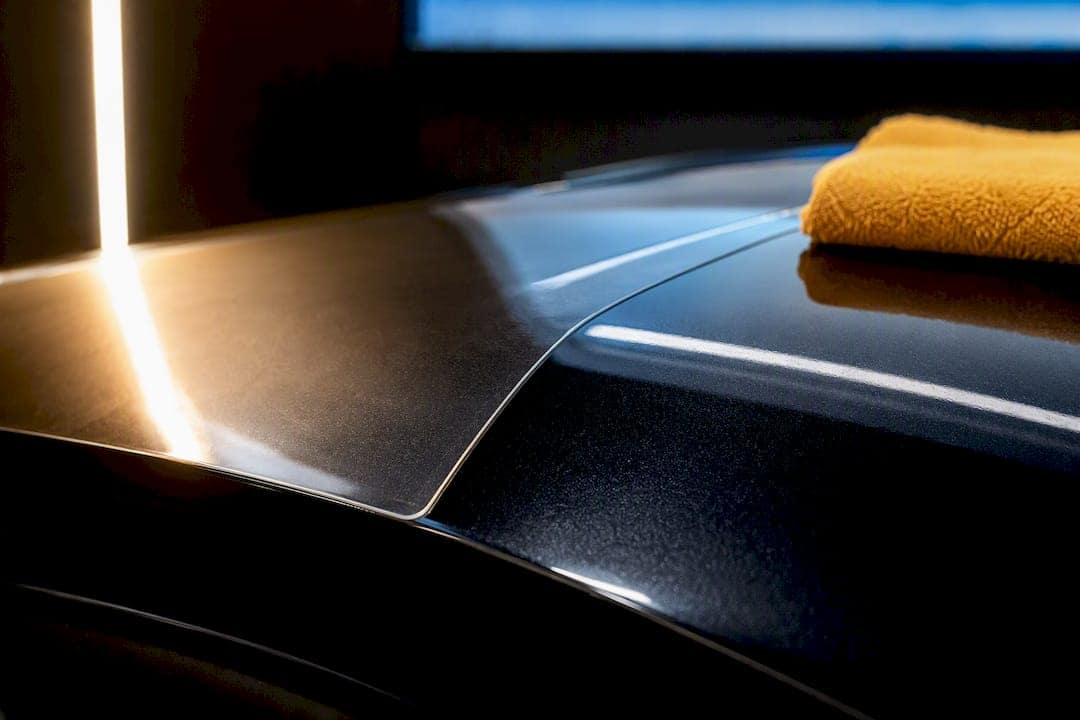
Ceramic coatings raise the surface hardness of a car’s clear coat and cut down on light swirls, water spots, and chemical etching from things like bird droppings and sap. They do not stop rock chips, key marks, or deep gouges, because a microscopic ceramic layer simply cannot absorb impact the way a multi-mil film like PPF can.
TL;DR:
- Ceramic coatings are primarily effective against wash-induced swirl marks, chemical etching, and gloss loss, but do not prevent impacts from rocks or key scratches.
- Their 9H hardness rating indicates scratch resistance to light, localized forces, but does not imply impact absorption or prevent deep damage like chips.
- Proper surface preparation and application are crucial; failure to correct existing damage or remove contaminants can lead to poor performance and disappointment.
- Paint protection film provides significant impact absorption with around 8 mils of thickness, better suited for impact zones like bumpers and hoods.
- Combining PPF on impact-prone areas with ceramic coating on the rest of the vehicle offers comprehensive long-term protection and easier maintenance.
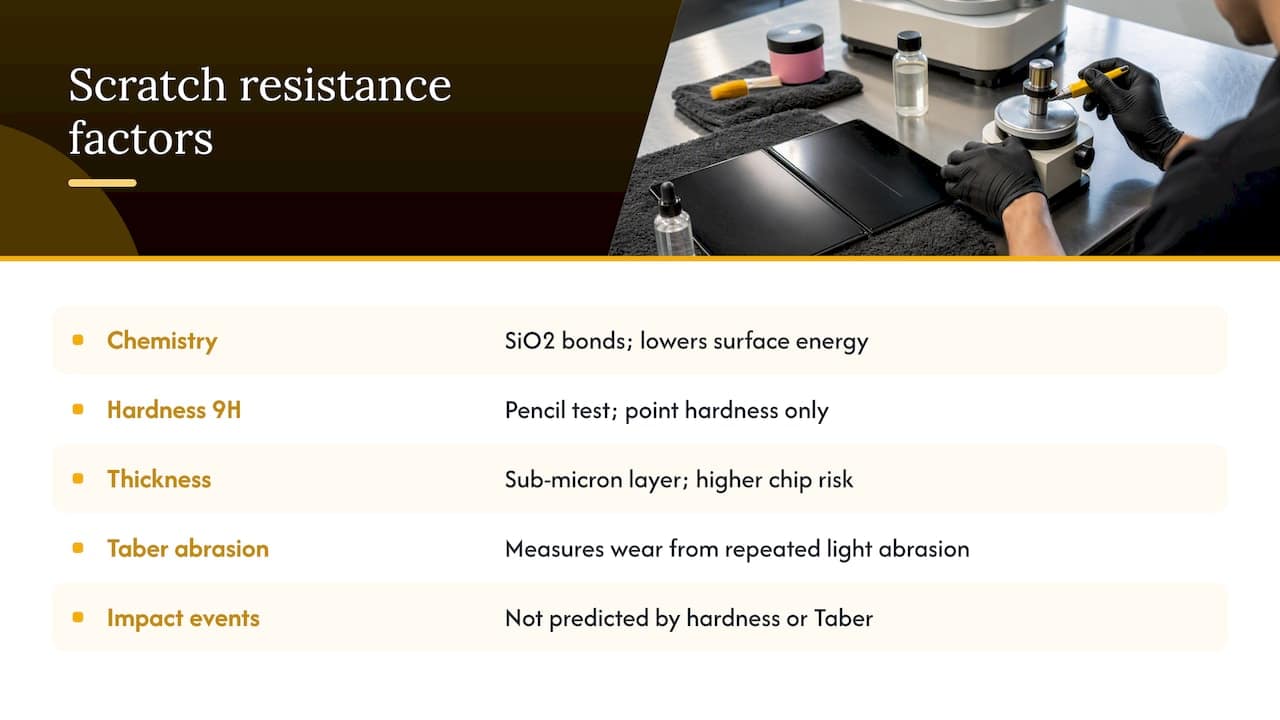
Ceramic coatings are built on silicon dioxide (SiO2) or related nano-ceramic compounds that bond chemically to the clear coat rather than just sitting on top of it. That bond lowers the paint’s surface energy, which is why contaminants and water slide off instead of grinding into the finish during a wash. The chemical cross-linking also stiffens the outermost layer of the clear coat, giving it more resistance to fine scratching than bare paint offers on its own.
This is where the “9H” rating you see on nearly every ceramic coating label comes from, and it is also where a lot of confusion starts. The 9H figure refers to pencil hardness, a test where graded pencils are pressed against a coated surface to see which hardness scratches it. A coating that resists a 9H pencil is genuinely harder than uncoated clear coat, but a pencil test applies a small, controlled point load, nothing like the concentrated force of a rock kicked up at highway speed or a key dragged across a door panel. Hardness measures resistance to a specific kind of light, localized stress. It says nothing about impact absorption.
Coating thickness matters just as much as chemistry. Most ceramic coatings measure in the sub-micron to low single-micron range once cured, a layer thinner than a human hair. That thinness is precisely why hardness alone cannot tell the whole story: a harder but extremely thin layer can still crack, chip, or wear through under enough force, because there is no bulk material behind it to flex or absorb energy.
Lab testing backs this distinction up. Taber abrasion testing, which measures material loss after repeated abrasive wheel contact, shows ceramic coatings holding up better than uncoated clear coat or older sealant products under repetitive light abrasion. That kind of test is a reasonable stand-in for years of wash-induced micro-scratching. It is a poor stand-in for a single high-energy event like a stone chip, which is a different physical problem entirely: sudden, concentrated impact rather than cumulative surface wear. Pencil hardness and Taber abrasion numbers are useful for comparing one coating’s scratch resistance to another’s, but neither test predicts how a car will fare against gravel on a rural highway.
The realistic case for ceramic coating rests on everyday wear, not collision-level damage. Three areas stand out where a properly applied coating earns its keep.
None of this requires exotic claims. It is simply the practical payoff of a harder, slicker surface that needs less aggressive scrubbing to keep clean. Owners who wash frequently, in dusty or high-pollen environments, see the biggest difference, since that is where repeated low-grade abrasion does most of the long-term damage to unprotected paint.
Marketing language like “scratch-proof” and “permanent protection” has done real damage to how buyers understand this product. A few corrections matter here.
The gap between what a label promises and what a thin chemical layer can physically do is the single biggest source of buyer disappointment, and it has little to do with product quality once installation is done correctly.
The clearest way to understand the difference is thickness and mechanism. Modern PPF products like 3M’s Scotchgard Pro Series typically run around 8 mils thick, a physical barrier substantial enough to absorb the energy of a kicked-up stone before it ever reaches the paint. Ceramic coatings, by contrast, sit at a fraction of a mil: hard, slick, and chemically resistant, but with nothing behind them to cushion an impact. That gap in thickness, not a difference in “quality,” is why the two products solve different problems.
PPF also brings a feature ceramic coating cannot replicate on its own. 3M describes its Scotchgard Pro Series film as self-healing, meaning minor scratches in the film’s clear top layer can disappear with heat exposure from sunlight or warm water. That property lets the film absorb years of minor scuffing without ever looking worn, something a hard ceramic layer, which does not flex or heal, cannot do.
The choice comes down to driving conditions and priorities:
There is no version of ceramic coating that closes this gap. The two products are complementary rather than competing, and treating them as interchangeable is where most buyer expectations go wrong.
Coating performance depends heavily on how a car is washed and maintained afterward. A few habits make the biggest difference.
Pro Tip: Check for water beading after every wash. Once water starts sheeting flat instead of beading tightly, the coating’s hydrophobic layer is wearing thin and it’s time to plan a maintenance detail or refresh.
Persistent water spots that do not wipe away easily, along with a loss of that beading effect, are the two clearest signs a coating is aging. At that point, a maintenance wash and possible topper product can extend performance, though a full refresh eventually becomes worthwhile on high-mileage or heavily exposed vehicles. For actual damage such as a fresh scratch or chip, small marks can sometimes be minimized with a light polish, but anything reaching the base coat calls for professional paint correction or, where the damage is in a chip-prone zone, a PPF repair rather than another coating layer. Owners looking for a fuller ceramic coating wash routine can find more detail in dedicated maintenance guides.
The PPF Company works across paint protection film, ceramic coatings, and combined packages, and the pattern its installers see most often is not a coating failing on its own merits, it is a coating asked to do a film’s job. Chip protection and chemical resistance are different engineering problems, and treating them as one leads to disappointment regardless of which product a customer bought.
The steps that most affect real-world outcomes rarely make it into marketing copy: paint correction before any coating or film goes on, correct coverage zone selection so PPF goes where impact risk is highest rather than blanket-applied out of habit, and clear post-install care instructions so owners know curing time, first-wash timing, and what early wear looks like. Coatings and films applied over unpropped paint or without proper coverage planning underperform even when the product itself is sound. Owners dealing with early wear signs like fading water beading can also review restoring ceramic coating beading for a practical fix before assuming a full reapplication is needed.

If you spend real time on highways or gravel roads, put PPF on the panels that take the hits: front bumper, hood, mirrors, rockers. If your priority is gloss, easier washing, and chemical resistance in lower-debris driving, ceramic coating alone covers most of what you need. Combining both, film on impact zones and ceramic over the rest of the body, gives the strongest long-term case for preserving resale value, since it protects the two things buyers actually notice: chip-free paint and a finish that still looks freshly detailed. Think in coverage zones, not “the whole car needs the same treatment”: that is where most protection budgets are spent inefficiently.
If the science above tells you PPF, ceramic coating, or both make sense for your driving, the practical difference between our packages comes down to coverage and film grade rather than the underlying protection technology. Deluxe Fusion and Standard Fusion pair PPF with ceramic coating for combined chip and chemical protection, while the PPF packages scale coverage from key impact zones up to fuller body protection. Current prices are on the pricing page.
A typical appointment starts with a paint inspection and correction where needed, since coatings and film both perform better on properly prepped paint, followed by installation and a walkthrough of care instructions and warranty coverage.
Book a look at your Calgary ceramic coating options or explore PPF coverage plans to find the right combination for how you actually drive.
The main downside is that it cannot prevent rock chips, key scratches, or deep gouges, since the layer is only a fraction of a millimeter thick. It also requires proper paint correction and surface prep beforehand, or it will lock in existing swirls and underperform regardless of the product’s quality.
No, a ceramic coating does not fill in or repair existing scratches; it forms a hard, thin layer over the paint that helps prevent new light swirls and chemical etching. Any scratch that already reaches the base coat needs paint correction or, in chip-prone areas, PPF repair rather than a fresh coating application.
Ceramic coatings pass high pencil hardness ratings like 9H and perform well in Taber abrasion testing against uncoated clear coat, meaning they resist the light, repetitive abrasion that causes wash-induced swirl marks. That resistance does not extend to concentrated impacts like stone chips, since hardness and impact absorption are different physical properties.
Neither is universally better, they solve different problems: PPF’s roughly 8-mil thickness absorbs physical impacts like rock chips, while ceramic coating offers chemical resistance and easier maintenance through a harder, hydrophobic surface. Frequent highway drivers benefit most from PPF on impact zones, while owners prioritizing gloss and easy cleaning often do well with ceramic coating alone, and many owners combine both for full coverage.