
Professional ceramic coating in Canada typically runs $800 to $2,500 or more, with most daily drivers landing in the $1,000 to $1,600 sweet spot. The number that matters most isn’t the coating itself. It’s how much paint correction your car needs before anything gets applied. Walk away from any quote under $500 that promises “lifetime” protection with no written scope of work.
TL;DR:
- A professional ceramic coating in Canada averages $800 to $2,500, but the price largely depends on the paint correction needed before application.
- The main cost drivers are labor hours for paint correction, vehicle size, and warranty length, not the coating material itself.
- Lower-cost packages often skip proper correction and use lower-grade products, risking faster degradation, especially in harsh Canadian winters.
- The actual application process requires several days, including curing time, and pricing can increase significantly with add-ons like wheel or glass protection.
- A thorough assessment of your vehicle’s paint condition is essential to avoid under- or over-paying for a service that may not meet your durability expectations.
The gap between a $600 quote and a $2,200 quote almost never comes down to the bottle of coating. It comes down to labor hours, vehicle size, and how much correction the paint needs before the coating goes on.
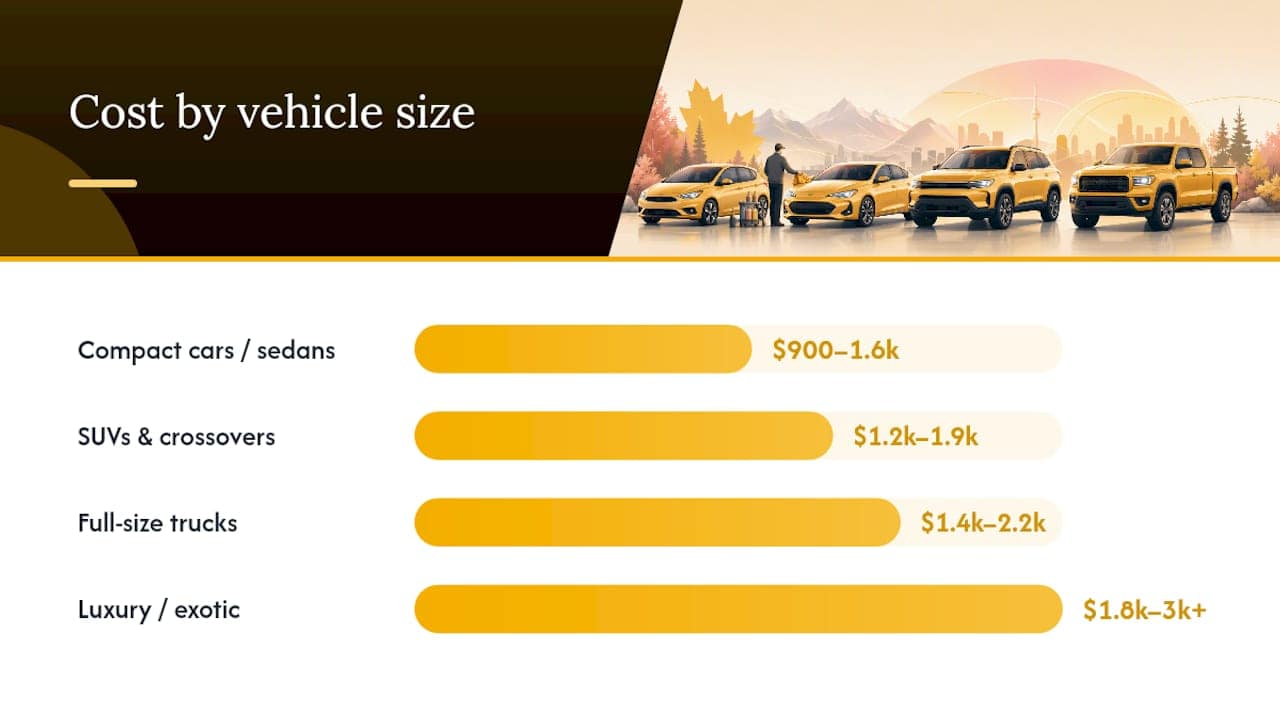
Entry-level packages, often marketed as one-year sealants rather than true ceramic coatings, sit around $300 to $600. These skip most paint correction and use lower-grade products that break down faster under Canadian winters. Mid-range professional coatings for a compact or mid-size sedan run $1,000 to $1,600, covering a proper multi-stage polish and a real 5 to 7-year product.
Larger vehicles cost more because there’s simply more surface area to correct and coat:
Regional pricing shifts too. Coastal markets like Vancouver tend to run slightly higher because of overhead and steady demand, while Prairie cities like Calgary and Edmonton sit closer to the midrange, driven by strong seasonal demand for winter protection against road salt and gravel.
The liquid itself is cheap. Most professional-grade ceramic coatings cost the shop $100 to $300 per vehicle application. Everything else on your invoice is labor, equipment, and process, which is why two quotes for the “same” service can differ by $1,000.
Here’s what actually drives the price up:
A shop that can’t explain which correction stage your car needs, and how long it will take, is guessing at your price rather than calculating it.
Pro Tip: Ask the shop to write the correction stage (single, two-stage, or multi-stage) directly on your invoice. If a defect isn’t sealed correctly under the coating, that paperwork is your proof of what was actually done.
Price brackets only mean something once you know what’s inside them. Here’s a realistic breakdown of what Canadian shops deliver at each level.
Whatever bracket you’re in, get the correction stage, product name, and warranty terms in writing before you pay a deposit.
A DIY kit plus supporting supplies (clay bar, polish, applicators, microfiber towels) typically runs $150 to $350, and eats up a full weekend if you want it done right. The math looks appealing until you factor in what goes wrong.
Uneven application, high spots, and streaking are common when coating is applied without controlled humidity or proper surface prep, and any swirl or contamination sealed underneath stays there for years. Professional coatings last 3 to 7 years; DIY kits typically last 1 to 2 years before they start sheeting unevenly. In a climate where road salt and gravel chip are a real threat six months a year, that shorter lifespan matters more here than in milder markets.
| Factor | DIY kit | Professional install |
|---|---|---|
| Typical cost | $80 to $350 | $800 to $2,500+ |
| Paint correction included | No | Yes, single- to multi-stage |
| Typical lifespan | 1 to 2 years | 3 to 7 years |
| Warranty | None | Written, often with recertification |
The questions you ask on the phone tell you more than the price quoted. Push for specifics before you book.
Refuse any shop offering same-day “full ceramic coating” on a heavily swirled car. Proper correction and cure time simply take longer than a few hours. Curbside operators working in direct sun or dusty lots also can’t control the environment a coating needs to bond correctly.
Pro Tip: When comparing quotes, normalize for vehicle condition. A $1,200 quote on a car with heavy swirl marks and an $1,800 quote on the same car with the same correction included aren’t actually far apart once you account for the labor difference.
The PPF Company brings 30-plus years of combined experience in paint protection, which shows up most in how correction stages get assessed before a single coat goes on. Calgary and Winnipeg both see harsh freeze-thaw cycles and heavy road salt exposure, and the coating systems and prep steps The PPF Company uses account for that rather than treating every vehicle the same.
Details on service scope and expected performance in local weather are outlined on the Calgary ceramic coating page.
The quoted price on a ceramic coating estimate is rarely the final number on your card statement. Alberta and Manitoba both apply GST at 5% with no separate provincial sales tax on services in either province, so a $1,400 mid-range package lands closer to $1,470 once tax is added. That’s simpler than provinces layering HST, but it still catches people off guard when they’ve budgeted only the sticker price.
Beyond tax, ask about deposit requirements. Many shops take 20 to 50% down to book your slot, especially during spring and fall rush when everyone wants protection before winter or after it. Add-ons like wheel coating, glass treatment, or interior protection get quoted separately and can push a $1,200 base job to $1,500 or more once you say yes to the extras during drop-off.
Tipping isn’t standard practice at detailing and coating shops the way it is at a restaurant, since pricing already reflects skilled labor. If a technician went well beyond the agreed scope, a modest tip is appreciated but never expected or requested.
Financing is worth asking about directly. Several Canadian shops offer payment plans once a package crosses roughly $1,000, which can make the difference between settling for an entry package and getting the mid-range correction your paint actually needs.

Booking to keys-back usually spans a window, not a single appointment. Most shops book two to four weeks out during peak spring and fall seasons, less if you catch a slow week in midwinter.
The appointment itself typically takes one to three full days depending on correction needs. A car needing only light decontamination and a single-stage polish might be ready in a single day. A vehicle with heavy swirling, old touch-up paint, or oxidation needing multi-stage correction can tie up a bay for two to three days once you include cure time between coating layers.
Cure time is the part owners underestimate most. The coating needs to bond and cross-link before it can handle a wash or rain exposure, which typically means the car sits in a controlled space for 12 to 24 hours minimum after the final layer goes on. Some shops ask you to avoid washing the vehicle for 7 to 10 days afterward while the coating fully hardens.
Plan your booking around this reality: if you need the car back for a road trip or event, book at least a month ahead and confirm the shop’s specific cure and pickup timeline rather than assuming next-day service.
Most articles on this topic treat price as the whole story. It isn’t. The real question is whether the quote in front of you reflects an honest assessment of your paint’s condition, or a flat number pulled from a price sheet regardless of what your car actually needs.
Conventional advice tells you to “get three quotes and pick the middle one.” That’s a mistake if the three quotes aren’t scoped the same way. A $700 quote that skips correction and a $1,400 quote that includes two-stage polishing aren’t competing offers. They’re different services wearing the same label.
Prioritize this: ask every shop to name the correction stage before they name a price. In Prairie climates especially, where salt and gravel do real damage over a winter, skipping correction to save $400 upfront often costs more in resealing within eighteen months. Pay for the assessment, not just the coating.
The PPF Company inspects your paint before quoting anything, checking for swirl marks, oxidation, and prior repair work to recommend the correction stage your car actually needs rather than a one-size price. Vehicle size, current condition, and your preferred warranty length all factor into the number you’re given, and nothing gets scheduled until that scope is written down.
Turnaround typically runs one to three days depending on correction needs, with documentation and warranty terms handed over at pickup so you know exactly what was done and what recertification requires down the line. Calgary owners can review packages and book directly through the Ceramic Coating Calgary page, while Winnipeg drivers have the same process available through Winnipeg Ceramic Coating. If rock chips are a bigger concern than UV fading for your vehicle, ask about pairing coating with paint protection film during the same visit. Reach out through either local page to get your vehicle assessed and a written quote in hand.
Professional ceramic coating in Canada typically costs $800 to $2,500 or more, with most sedans and daily drivers landing between $1,000 and $1,600 depending on paint condition and product warranty.
For most Canadian drivers facing road salt, gravel, and freeze-thaw cycles, yes. A properly applied coating lasting 3 to 7 years reduces washing frequency and protects clear coat far longer than wax or a DIY sealant.
It doesn’t prevent rock chips or scratches from debris, since it’s a chemical bond, not a physical barrier film. Vehicles facing heavy highway or gravel-road exposure often benefit more from paint protection film in high-impact zones alongside the coating.
Professional-grade coatings typically last 3 to 7 years depending on product tier and maintenance, while DIY kits usually wear down within 1 to 2 years.