
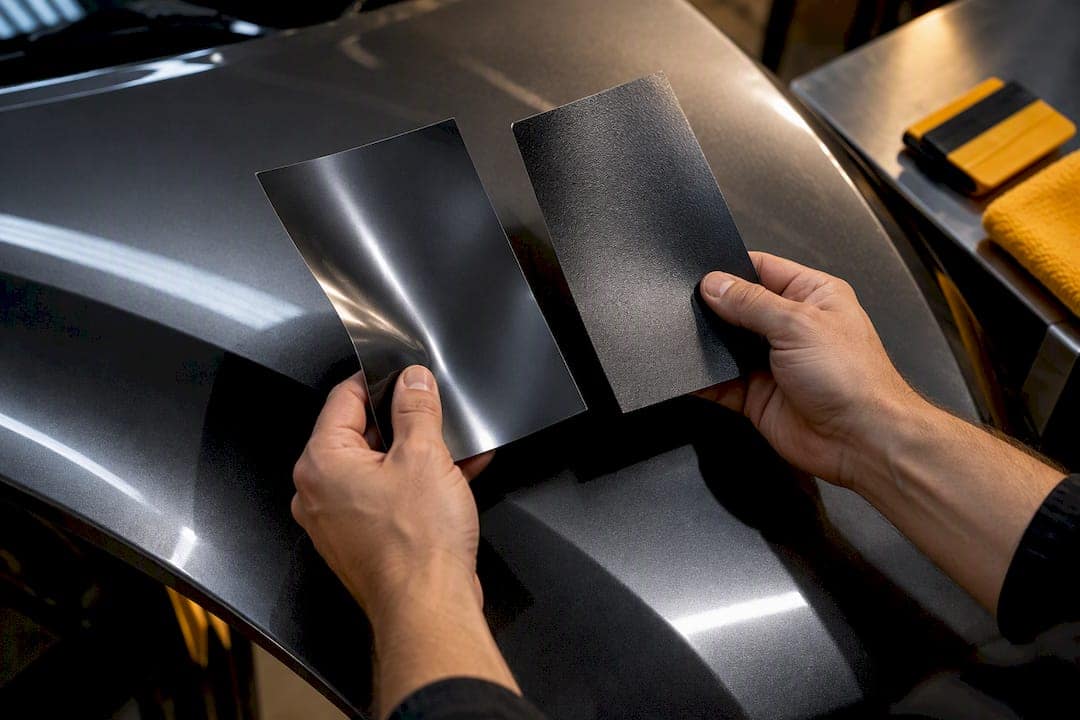
Choose cast vinyl for complex curves, rivets, and long-term vehicle wraps; choose calendered vinyl for flat panels, short-term promotions, and tighter budgets. The trade-off comes down to three things: cast conforms better and lasts longer, calendered costs less upfront but shrinks more and ages faster. Everything below explains why, so you can match the right film to the right job instead of guessing.
TL;DR:
- Cast vinyl offers superior conformability and durability for complex curves, rivets, and long-term outdoor applications, lasting up to 7 years.
- Calendered vinyl is cheaper upfront, thicker, and easier to handle on flat surfaces but shrinks more and ages faster, making it suitable for short-term projects.
- Matching the film type to the surface shape and lifespan is essential, with cast for curves and long-term use, and calendered for flat, temporary graphics.
- Proper pairing of film and laminate is critical, as incompatible combinations can cause early failure due to different shrink rates and thermal expansion.
- Professional installation and correct film selection can prevent common issues like lifting, air bubbles, and mismatched laminates, extending product lifespan.
The two films behave differently because of how they are made, and that shows up in every performance category that matters for a graphics project.
Manufacturers including 3M, Avery Dennison, and Arlon sell both film types for these reasons, positioning cast lines for wraps and calendered lines for flat or shorter-term graphics.
Cast vinyl starts as a liquid resin mixture poured onto a casting sheet, then cured as the solvents evaporate. That process leaves the film in a relaxed, low-stress state, which is why it stretches over compound curves without fighting back or springing back later.
Calendered vinyl starts as a molten PVC mix that gets squeezed through a series of heated rollers. Rolling stretches the material mechanically, so the finished film carries built-in tension, often called mechanical memory, and tends to be thicker as a result.
Cast face film commonly measures about 50 microns, or roughly 2.0 mil, a gauge manufacturer data sheets tie directly to the film’s low shrinkage and high conformability.
Published durability ratings only tell part of the story. Heat, UV exposure, and surface geometry all push actual lifespan up or down from the number on the data sheet.
Calendered film’s higher shrink tendency, commonly cited in the 3 to 6 mil gauge range, is the main reason it struggles on anything but flat, low-stress surfaces. Environment matters too: a wrap parked outdoors in direct sun year round will age faster than the same film on a garaged vehicle, regardless of which type you chose.
Picking the right film gets simpler once you sort projects by shape and expected lifespan rather than by price alone.
A quick way to decide: if the surface has curves, rivets, or compound bends, go cast. If the job is flat and temporary, calendered saves money. If the graphic needs to survive several years outdoors, the durability gap favors cast even at a higher upfront cost.
The single most common cause of early graphic failure is pairing film and laminate with different shrink rates. Industry guidance repeatedly warns against mixing cast and calendered laminates, because the two materials expand and contract at different rates once installed, and that mismatch pulls seams apart over time. The most common installation mistake installers report is exactly this pairing, and manufacturers often sell matched film and laminate systems specifically to prevent it.
Pro Tip: Check the film’s own product data sheet for its recommended overlaminate before you buy, since warranty coverage on most wraps depends on using a matched system.
Routine care extends either film type well past a neglected install, but the right approach differs slightly by material.
Pro Tip: Keep a copy of the installation date and film type on file, since matching future touch ups or removal methods gets much easier when you know exactly what is on the vehicle. For deeper cleaning routines, see our guide on vinyl wrap maintenance.
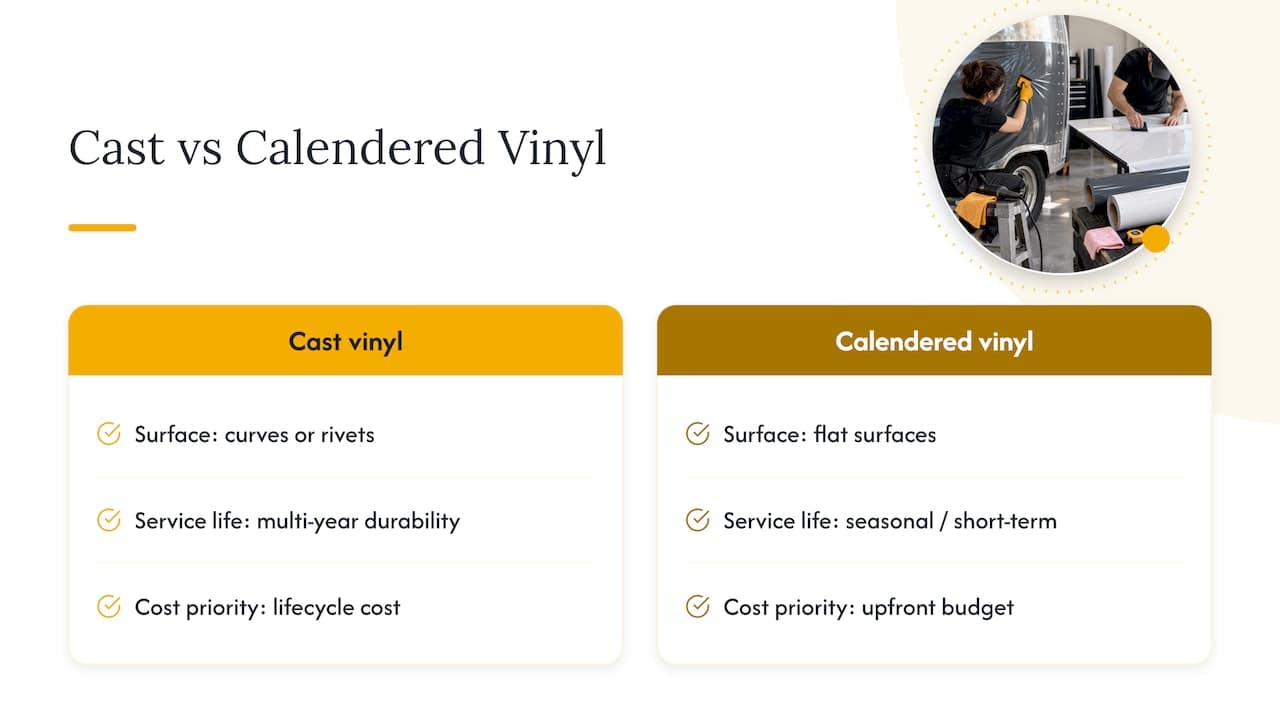
Three questions settle most decisions. First, does the surface have curves or rivets, or is it flat? Second, do you need the graphic to last multiple years or just a season? Third, is upfront cost or total lifecycle cost the priority? Match complex, long-term jobs to cast vinyl and flat, short-term, budget-driven jobs to calendered vinyl, and you will avoid the most common source of early failure.
Every wrap job teaches something new about how film behaves under real conditions, not just on a data sheet. Complex panels punish the wrong film choice fast, usually within the first hot summer. [author_bio] [brand_signal] [testimonial] [internal_data] For anything beyond a flat, low-stakes panel, professional installation avoids the guesswork that turns a good film choice into a failed one.
Choosing the right film only solves half the problem. Getting it installed without air bubbles, lifted edges, or mismatched laminates is the other half, and that is where a professional install pays for itself. Professional installers work with:
Matching film and laminate systems on every install is important to prevent peeling within a year, a step often missed on rushed DIY jobs. Explore our Calgary paint protection film services or browse the full lineup at The PPF Company to request a quote for your vehicle.
Calendered vinyl is a vinyl film made by extruding molten PVC and rolling it through calendering machines, which produces a thicker film with built-in mechanical memory. It works well on flat surfaces and shorter-term graphics because it resists stretching over curves compared to cast vinyl.
Cast vinyl is poured and cured in a relaxed state, making it thin, highly conformable, and dimensionally stable, while calendered vinyl is rolled under mechanical stress, making it thicker and more prone to shrinking. Cast films generally carry longer durability ratings, up to 7 years on premium lines, compared to calendered films in the 1 to 7 year range.
Vvivid is a third-party vinyl brand, and specific product lines vary between cast and calendered construction depending on the exact product. Check that product’s own data sheet for its construction type and durability rating before buying.
Cast vinyl is produced by pouring a liquid vinyl mixture onto a casting sheet and curing it, which results in a thin, relaxed film that conforms easily to curves and rivets. It is the preferred choice for full vehicle wraps and other complex, long-term applications.
Mixing cast film with calendered laminate is not recommended, since the two materials shrink at different rates and this mismatch is a common cause of premature graphic failure. Matching film and laminate types, as manufacturers specify on their data sheets, protects both appearance and warranty coverage.